
Skills of the Future
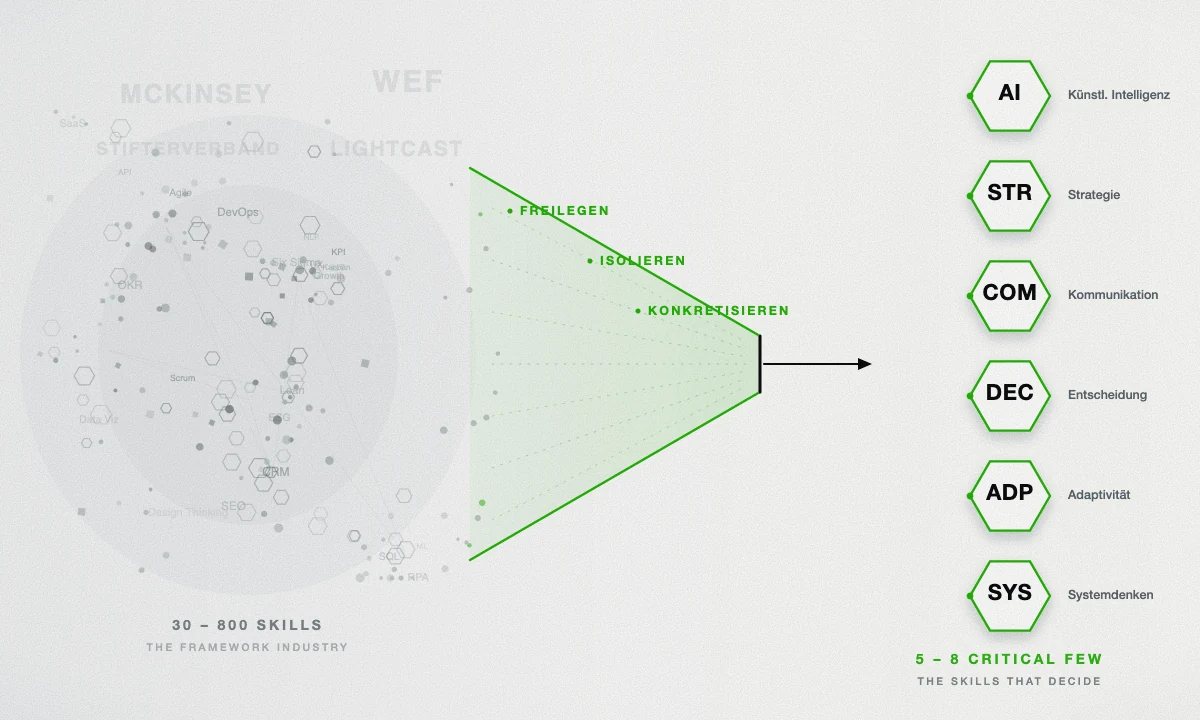
The board question is on the slide: Which skills carry your strategy? On the table sit the WEF report, a Stifterverband framework and a McKinsey extract. Together they add up to between thirty and eight hundred skills. What they do not add up to is an answer.
Anyone searching for "Skills of the Future" today as a managing director of a mid-market firm runs into a framework industry. WEF, McKinsey, Stifterverband, Bersin, Skillsoft, Korn Ferry, Workday, Eightfold. Every vendor has a catalogue, a taxonomy, a cloud, an index. What no one sells is the reduction: pulling out from thirty to eight hundred skills the five to eight on which your strategy for the next twenty-four months concretely depends. This is exactly the gap that the HIHB Horizon method on hireworks.de closes - in a workshop with leadership, HR and business lead at the table.
This article is the pillar of an edition with five texts on skill strategy in the mid-market. It places the four most important frameworks, shows why they do not give an answer at the level of the individual company, and describes the mechanism HIHB offers instead: Pre-Recruiting at strategic level - the clarification of the skill question before the first critical hire is posted.
1What the framework industry sells
Four vendors shape the discourse on "Skills of the Future" in the German-speaking market: the World Economic Forum, McKinsey, the Stifterverband and the skill-cloud vendors. Each fills a different need. None delivers an answer to the question a mid-market managing director puts on the table at Monday's leadership meeting.
WEF Future of Jobs Report 2025 - the market survey
The Future of Jobs Report 2025 is probably the most-cited document on the skill question. More than one thousand employers, fourteen million employees, twenty-two industry clusters, fifty-five economies. The WEF's core findings have entered the discourse: thirty-nine percent of today's core skills will be transformed or obsolete by 2030. Sixty-three percent of employers see skill gaps as the largest barrier to business transformation in the years 2025 to 2030. Eighty-five percent plan to prioritise upskilling; seventy percent expect to hire new employees with new skills.
What the WEF report achieves: it proves that the skill shift is real, that it cuts across industries and that within the next five years it will reach a magnitude that is impossible to ignore strategically. What it does not achieve: it tells a single managing director nothing about which skills are the critical ones for their company. The WEF skill catalogue lists about one hundred and fifty skill terms, grouped into clusters such as analytical thinking, resilience, AI and big data, technological competence, curiosity and lifelong learning. A market observation. Not an answer for a company.
McKinsey State of Organizations 2023 - the capability gap
McKinsey, in State of Organizations 2023, captures a finding that compresses the urgency of the skill question into a single number: only five percent of organisations surveyed say they have the capabilities they need to reach their goals. Six percent consider themselves already too late. Forty-three percent say they need to act now. Forty-seven percent see action required in the foreseeable future.
Anyone who reads this number has two reactions. The first is relief: you are not alone, ninety percent of organisations see the same pressure. The second is the uncomfortable question: what does this mean for my company? McKinsey does not answer it. The report describes an aggregate market finding. It does not hand over a method by which leadership can pull its own Critical Few out of that aggregate.
Stifterverband Future Skills 2030 - the German catalogue
The Stifterverband published its updated Future Skills framework in December 2025. Thirty future skills across five categories: foundational, transformative, community-oriented, digital and technological future skills. More than one thousand stakeholders surveyed confirm the overall relevance of the framework. In the German education and HR debate, the Stifterverband catalogue is the standard reference.
The strength of the Stifterverband framework: high content quality, clear structure, good connectivity to education programmes. The finding at company level is identical to that of the WEF and McKinsey: thirty competencies are a map, not a route. Any mid-market manager looking for the five skills on which the next product innovation depends will find the menu inside the framework, but not the menu-selection method.
Skill clouds (Workday, Eightfold, Lightcast) - the database logic
At the other end of the spectrum sit the skill-cloud vendors. Workday Skills Cloud, Eightfold Talent Intelligence, Lightcast Open Skills, Korn Ferry Success Profiles. Here nothing is reduced - here things are multiplied. The promise: skills are inferred from job ads, CVs and internal profiles, in real time, in a database that depending on the vendor holds between several thousand and several tens of thousands of skill entries. Lightcast Open Skills contains around thirty thousand skills.
The Sevoir Group describes the reality behind this promise in "Why Skills Taxonomy Projects Fail": skill-taxonomy data is notoriously hard to consolidate, maintenance becomes an overwhelming burden, and while the rollout is still running, the taxonomy is already out of date because the requirements have moved on. Implementations collapse with predictable regularity - not because the technology does not work, but because the strategy question was skipped. Josh Bersin's "Sober Reality" piece arrives at the same conclusion from a different direction: nearly every company wants to become a skills-based organisation, but very few have a reproducible method for doing so.
The shared finding: four frameworks, no reduction
The four vendors differ in scope, methodology and audience. In one property they are identical: none of them delivers a reduction method for the individual company.
| Framework | Skill count | What it delivers | What it does not deliver |
|---|---|---|---|
| WEF Future of Jobs 2025 | ~150 | Market observation, trend analysis, industry clusters | Reduction to the individual company |
| McKinsey State of Organizations 2023 | Cluster-based | Urgency finding, 5/47/43 distribution | Methodology for Critical Few identification |
| Stifterverband Future Skills 2030 | 30 in 5 categories | German consensus catalogue, education link | Selection method for the individual company |
| Skill clouds (Lightcast, Workday, Eightfold) | 3,000 - 30,000 | Data inference from CVs and job ads | Strategy link, Critical Few reduction |
The framework industry sells catalogues. It does not sell decisions. That is not its failure - that is its job. Market observation and strategic decision are different disciplines. Confusing the two is the most common mistake in the first twelve months of a skill strategy.
2Why 30+ skills are never implemented in the mid-market
Picture a CHRO at an industrial company with one thousand five hundred employees who receives the brief from leadership: "Develop a skill strategy for the next three years." She takes the Stifterverband framework as her foundation. Thirty skills across five categories. She allocates them to business units, maps them to functions, builds a skill profile per role. After six weeks a twenty-four-page document lands on the table. It reads well. Nothing happens.
I have seen this pattern in more than two hundred mandates across DACH and Benelux. The question is not why the CHRO did not get further. The question is why a carefully built skill architecture systematically ends up in a drawer in the mid-market. Three reasons.
Reason 1: skill lists cannot prioritise
A list of thirty skills is democratic. Every skill stands equally on the page. That is the nature of a list - and exactly its weakness when a strategic decision is at stake. A leadership team cannot invest in thirty skills simultaneously. They can invest in three, perhaps in five, in rare cases in eight. Anyone who does not reduce decides implicitly about allocation - in a way that distributes a little to every skill by the end of the year, and enough to none.
McKinsey captures this finding in a single number: five percent of organisations say they have the capabilities they need. The other ninety-five percent have skill strategies, but not the skills. The difference between the two is the reduction.
Reason 2: behavioural resolution is missing
A skill label is a drawer. "AI competence" appears in thousands of job ads. What it concretely means has rarely been spelled out. Four candidates claim in the interview that they have AI competence. Three mean operating ChatGPT, one means model evaluation, one means prompt engineering. By the ninety-day plan it turns out the hiring manager picked the wrong one. Not because the skill label was wrong - but because the skill label was never resolved.
Skill frameworks are structurally vague at this point. They name the skill, outline its meaning, group it into a category. They do not say what a person who has this skill actually does - in observable behaviour that is testable in the interview, in the ninety-day plan and in the performance review. Behavioural resolution is the methodical bridge between skill label and hiring decision. It is the most expensive gap in the standard toolbox.
Reason 3: triad consensus is missing
In the workshops I facilitate, the key to Critical Few reduction does not sit in a single person. It sits in the triad of leadership, HR lead and business lead. Leadership knows the strategy. HR knows the workforce. The business lead knows operational reality. As long as these three views do not come together in one room, every skill list is read through the respective lens - and no one finds the shared picture.
The Stifterverband framework reads differently from an HR perspective than from a leadership perspective. The WEF report reads differently from a business unit's perspective than from a C-level perspective. Any CHRO who builds the skill strategy alone inevitably builds it against an unspoken consensus. Anyone who presents it alone carries the downstream risk alone. This is exactly the risk that makes skill strategies in the mid-market end up in a drawer.
The DIHK finding: the mid-market is hit hardest
The DIHK-Fachkraeftereport 2025/2026 makes the urgency of this reduction question explicit for the mid-market: mid-market firms with two hundred to nine hundred and ninety-nine employees are hit hardest by hiring difficulties - forty-seven percent cannot fill positions because they cannot find suitable people. For companies with twenty to one hundred and ninety-nine employees the figure is forty-four percent. By comparison: for large corporates with more than one thousand employees it is forty percent.
The mid-market is therefore not less affected but more. At the same time it has fewer HR resources, less prior experience with skill architecture and less tolerance for multi-year skill-cloud rollouts. For mid-market firms, reducing to the Critical Few is not a question of elegance but of necessity.
3The HIHB answer: Critical Few reduction
Critical Few is not a new concept. Pareto described it more than a hundred years ago, Jim Collins popularised it as a strategic method in "Good to Great", Josh Bersin has picked it up several times in the skill context. What HIHB adds is the mechanism of reduction: a reproducible three-step method that takes a triad of leadership, HR lead and business lead from a long list to five to eight Critical Few in a single day.
Step 1 - Surface
The workshop starts with the strategy, not with skills. Which three to five strategic goals carry the next twenty-four months? Market entry, product launch, geographic expansion, margin improvement, digitisation programme. For each goal one and only one question is asked: Which capability decides whether we deliver it?
The question is sharp by design. It forces people out of the comfort zone of skill completeness. "We also need this one" is a standard reaction - and exactly the reaction that lands in the ninety-five percent who do not implement their skill strategy. The reduction question forces a decision. At the end of step 1 there are between fifteen and twenty-five skill candidates on the wall.
Step 2 - Isolate
From fifteen to twenty-five candidates emerge five to eight Critical Few. The mechanism is a prioritisation exercise I have seen hold up across two hundred mandates: every participant has one hundred percent of allocation points and distributes them across the candidates. Anyone who weights everything equally exhausts their score in three seconds. Anyone who reduces sees immediately which skills are high priority for whom.
The real work begins in the conversation about the allocation conflicts. Leadership has put a skill at forty percent, the business lead has put the same skill at five percent. The conflict is diagnostic. It shows that either the strategic goal is not clear or operational reality was not understood. Both cases are the place where the workshop earns its value: the unspoken assumptions become visible in a facilitated discussion. At the end of step 2, five to eight Critical Few stand with consensus.
Step 3 - Concretise
A skill label is not yet a decision. It only becomes one when it is translated into observable behaviour. Step 3 turns every Critical Few into two to three behavioural anchors: concrete, testable behaviours by which one can tell in the interview, in the ninety-day plan and in the performance review whether the capability is present or not.
Example: the Critical Few "AI Literacy" resolves into three behavioural anchors. First: the person can defend an AI output against their expert knowledge and says why they do not follow the machine. Second: the person makes a reproducible decision about whether a model is hallucinating or whether they themselves are mistaken. Third: the person explains to a non-expert in two minutes why an AI tool is suitable for one use case and not for another. These three anchors are testable in the interview. They are operational in the ninety-day plan. They are documentable in the performance review.
The methodological kinship to the HIHB 5C Method is not accidental. Both methods make the implicit explicit, both work through triad consensus, both end in behavioural description. Horizon is the strategic sister of the 5C Method: 5C clarifies a single critical hire, Horizon clarifies the skill architecture in which several critical hires take place.
4What HIHB Horizon actually does
HIHB Horizon on hireworks.de is the operational implementation of the Critical Few method. Four structural properties separate the Horizon workshop from a classic skill-strategy consultancy or a skill-cloud rollout.
Property 1: triad at the table
Leadership, HR lead and business lead sit in the room at the same time. Not in turns, not in separate workshops, not in email approval loops. This methodological point is non-trivial. A skill strategy without a leadership anchor remains an HR effort. A skill strategy without HR reality remains a CEO wish. A skill strategy without the business lead remains theoretical. The triad is the smallest unit in which a skill decision becomes load-bearing.
From my workshops I know what happens when the triad is not complete. When leadership delegates, the skill strategy does not get through the board later. When HR was not in the room, they cannot carry the implementation. When the business lead was not involved, operationalisation fails through silent resistance. Completing the triad is the cheapest insurance against the most expensive omission.
Property 2: reduction instead of multiplication
Horizon does not expand a skill catalogue. Horizon reduces. At the end of the workshop there are five to eight Critical Few - and not thirty or eight hundred. This limit is methodologically enforced, not accidental. Anyone leaving the workshop with fifteen skills has not answered the reduction question. The mechanism from step 2 (the hundred-percent allocation) forces reduction because it surfaces the allocation conflicts and drives a decision.
Property 3: skill-adjacency map as output
For each Critical Few, a skill-adjacency map emerges in the workshop. It shows which internal profiles can close the gap to the Critical Few through short upskilling paths (six to twelve months) - so-called Tier 1 profiles. Which need medium paths (twelve to eighteen months) - Tier 2. Which will not close the gap within twenty-four months - Tier 3. This map is the bridge between abstract skill decision and concrete Build-before-Buy-or-Hire decision. It turns a skill strategy into a workforce-movement hypothesis without HR handing over personal data to external parties.
The skill-adjacency logic is closely related to internal mobility concepts, but goes one methodological step further: not just "who can develop?", but "in which order do we develop whom on which Critical Few?".
Property 4: behavioural anchors per skill
Anyone leaving the Horizon workshop has two to three behavioural anchors for every Critical Few. These anchors are directly usable - in the briefing of the next critical hire, in the interview guide, in the ninety-day plan. They close the gap between skill label and hiring decision that costs most companies money several times over.
The methodological connection to HIHB recruiting practice is direct: what is produced in the Horizon workshop as behavioural anchors flows one level down into the strategic briefing of the individual critical hire and on into the persona instead of a requirements list. Horizon is the strategic pre-clarification in which the skills are fixed - the downstream HIHB workshops use these skills to fill individual roles.
5Who benefits
HIHB Horizon is not the right choice for every company. Three factors decide whether a workshop carries.
Factor 1: company size between 500 and 3,000 employees
Below five hundred employees the skill question is usually tied more closely to individual critical hires - here the HIHB 5C Method at role level is the more efficient answer. Above three thousand employees, complexity grows so much that a Horizon workshop typically requires several business units and several iterations. In the corridor between - between five hundred and three thousand employees - sits the typical DACH mid-market. Here a Horizon day with the triad of leadership, HR and business lead works best.
Factor 2: strategy horizon of 18 to 24 months
Anyone without a strategy cannot derive Critical Few. The Horizon setup assumes that at least a strategy horizon of eighteen to twenty-four months is within reach. Three strategic goals are enough. They do not need to live in a glossy strategy paper. They need to be clear enough in the minds of leadership and the business lead to survive a discussion at the wall.
Factor 3: triad availability for one day
Leadership, HR lead and business lead must be able to free up one day together. That is the hardest slot in the calendar - and at the same time the most important precondition. Anyone who cannot get the triad together should postpone the workshop, not shrink it. A skill strategy without a triad is a skill strategy on probation.
The typical sponsors
In my last twelve Horizon mandates I have seen three recurring sponsor profiles. First: CHROs who have received the brief from the board to deliver a skill strategy and after three weeks notice that the Stifterverband framework does not answer the question. Second: managing directors with an upcoming strategy horizon who want to clarify the skill anchor in advance, before the strategy is communicated. Third: business leads with their own skill-investment budget who need consensus with leadership and HR before they commit funds.
What all three profiles share: they have noticed that the question "which skills?" is a different question from "which skills according to the WEF?". They are not looking for market observation. They are looking for a decision.
6Sequence: direction, skills, Build-before-Buy
Anyone leaving the Horizon workshop has three things on the table. First: three to five strategic goals in a form that is connected to the skill decisions. Second: five to eight Critical Few with behavioural anchors. Third: per Critical Few a skill-adjacency map with Tier 1, Tier 2 and Tier 3 profiles. These three outputs make the sequence of the next twelve months self-evident.
Step 1 - Direction: leadership communicates the skill strategy as part of the strategy horizon, not as an HR initiative. Skill strategy is strategic alignment, not a people programme. The Critical Few are communicated in connection with the strategic goals. Everyone in the company understands why these five skills count now.
Step 2 - Skills: for each Critical Few it is decided whether it is covered through Build, Buy or Hire. Tier 1 profiles from the adjacency map get upskilling programmes. Tier 2 profiles get longer development paths or move into the Build-versus-Buy decision. Critical Few for which no Tier 1 or Tier 2 profiles exist move into the critical-hire pipeline - this is the moment when the HIHB method hands over to role level.
Step 3 - Build-before-Buy: the individual critical hires that fall out of step 2 are operationalised with the HIHB method at role level. Here the behavioural anchors from the Horizon workshop are used directly - in the strategic briefing, in the persona, in the ninety-day plan. The handover between Horizon (strategic skill architecture) and HIHB Accelerator (individual critical hire) is methodologically engineered and verified in two-hundred-plus mandates.
The framework industry will keep producing catalogues. The WEF will publish the next Future of Jobs Report in 2027. McKinsey will write the next State of Organizations. The Stifterverband will update its framework. Skill clouds will infer ten thousand new skills. These catalogues are useful - as market observation, as discussion basis, as consensus anchor. They are not an answer to the question the board will put on the table next week.
The answer to that question has five to eight points. It fits on a single slide. It is written in the language of your company, not in the language of the WEF. And it is carried jointly by the triad of leadership, HR and business lead, because it was built jointly. That is Skills of the Future for a mid-market firm. Everything else is market observation.
Frequently asked questions
What are Skills of the Future, concretely?
Skills of the Future is a collective term for capabilities that employers and research institutes assume will decide competitiveness over the next five to ten years. The discourse lists 30 to 800 skills, depending on the vendor. Operationally, however, Skills of the Future for a single company is not the entire catalogue but the five to eight Critical Few Skills on which its own strategy concretely depends.
Why are the WEF or Stifterverband frameworks not enough?
WEF, McKinsey, Stifterverband and comparable frameworks deliver a valid market observation: which skills are gaining importance in aggregate. They do not deliver a reduction method down to the individual company. Anyone who wants to pull out the five skills that carry their strategy from a list of 30 will find no mechanism inside the framework. The reduction is a methodical achievement that goes beyond the catalogue.
What is the Critical Few approach?
Critical Few means: from the strategy of the next 24 months, five to eight key capabilities are extracted on which delivery concretely depends. The mechanism runs through three steps: surfacing the strategic goals, isolating the capabilities through a prioritisation exercise, concretising them in observable behaviour. The HIHB method facilitates these three steps in a workshop with leadership, HR and business lead.
For which companies is the Horizon workshop worthwhile?
HIHB Horizon is tailored to mid-market firms between 500 and 3,000 employees. Three preconditions apply: a strategy horizon of at least 18 to 24 months, several critical hires or skill-build decisions in the next year, and a triad of leadership, HR lead and business lead who can decide together in a single day.
How does Horizon differ from skill-cloud software?
A skill cloud infers hundreds to thousands of skills from CVs and job ads. It delivers data. It does not deliver a strategic decision. Horizon is the opposite: not a skill catalogue but a reduction method. At the end you have five to eight Critical Few with behavioural anchors, a Build-before-Buy-or-Hire decision and a skill-adjacency map. A skill cloud without reduction is expensive data infrastructure. Horizon without a skill cloud is a strategic decision.
What is Pre-Recruiting?
Pre-Recruiting is the discipline that precedes the search. It clarifies which role needs to be filled with which requirements, which mandate and which behaviour, before the first job ad is written. HIHB Horizon is the Pre-Recruiting step on a strategic level: not a single role but the five to eight Critical Few Skills that carry the next 24 months.

Leads the HIHB methodology at HireWorks. Has facilitated workshops since 2018 with founders, management boards, HR leaders and business leads across DACH mid-market firms, large corporates and start-ups. Pre-Recruiting pioneer and co-author of the HIHB Horizon method for strategic skill architecture.
Before your next skill strategy:
One day with the triad is worth more than six weeks of skill catalogue.
HIHB Horizon is the workshop in which thirty skills become the five to eight that carry your strategy. Leadership, HR lead and business lead at the table. Behavioural anchors, adjacency map and Build-before-Buy-or-Hire decision as output.
HIHB Horizon on hireworks.de