
The 5C Method: how to truly understand a critical role in two hours.
1Why 5C, and not a 12-stage process
The 5C Method is the heart of the HIHB Workshop format. It is a focused question sequence, executable in two hours, that moves in exactly five steps from the silent expectations of a role to a shared WHY among all stakeholders. It is short by design: any additional stage would increase workshop effort without delivering materially more clarity.
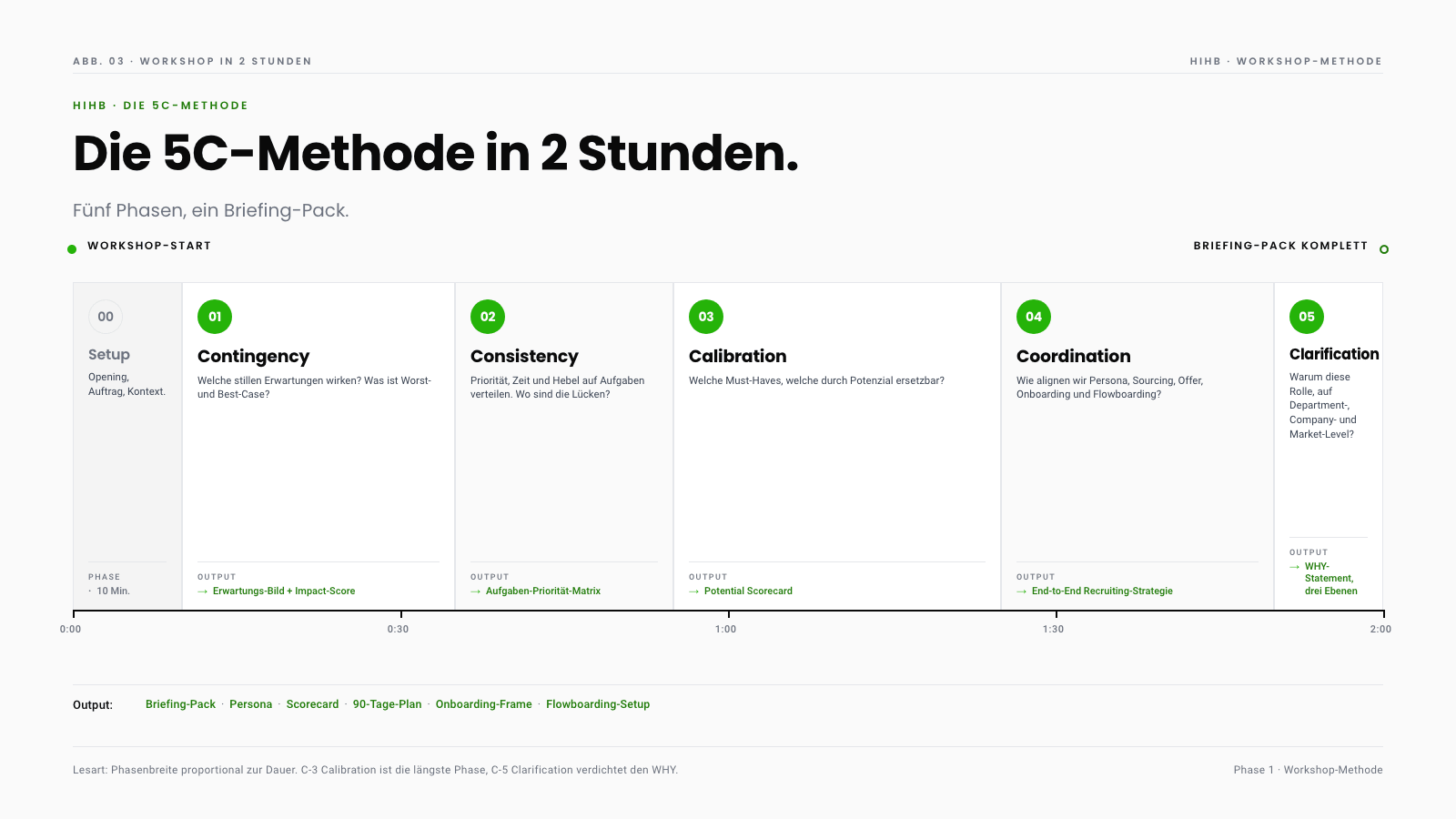
The five Cs stand for: Contingency, Consistency, Calibration, Coordination, Clarification. The sequence is fixed. Each step builds on the previous one and produces a concrete output artefact that then feeds into the persona, job ad, direct-search strategy, interview guide, onboarding plan, and review matrix.
2C-1 Contingency: surface the silent expectations
Contingency: wall, bridge, or invitation?
The current situation forms over a long stretch of time, through implicit shifts, and it carries enormous weight. What unspoken expectations of the role have quietly built up over that period? C-1 makes those expectations visible before they show up for the first time in a candidate conversation.
"Picture the current situation as an image: is it a wall to be climbed, a long or short bridge, or an invitation?"
The image is not a rhetorical device, it is a diagnostic tool. If three stakeholders draw three different images, that hour has just become the most important of the workshop. We then use impact scoring to draw out the strategic effect of a missing or poor hire versus an ideal one: worst case and best case.
A shared image of the current situation, impact scoring with worst- and best-case effect, documented as the starting point for every subsequent step.
3C-2 Consistency: distribute priority, time, and leverage across tasks
Consistency: the gaps become visible.
C-2 forces stakeholders to allocate priority, time, and leverage explicitly. 100% each. What becomes visible is usually what nobody had named before: tasks without matching goals, and goals without matching tasks.
"How do you distribute 100% priority across the goals, 100% time, and 100% leverage across the task groups?"
Before we distribute, we analyse how the organisation supports execution of the tasks. Are there dependencies? What do we do with them: lift them into onboarding, adjust the organisation, or carry them as a risk into the worst case? Three gaps are then checked: goals without matching tasks, tasks without matching goals, and time and leverage versus priority.
Task groups with allocated priorities, time, and leverage shares. Three gap diagnoses with consequences for persona, job ad, and onboarding.
4C-3 Calibration: balance must-haves with potential
Calibration: respond dynamically to high potential where a must-have is missing.
C-3 calibrates the job criteria so that non-negotiable must-haves come into balance with potential-based factors. Four potential factors structure the conversation: Learning Agility, Growth Mindset, Problem-Solving Skills, Transferable Skills.
"Which must-haves are truly non-negotiable, and which potential can compensate for a missing must-have?"
In the second half, we align three perspectives: hiring goals, candidate expectations, business needs. Optionally, a Potential Scorecard rounds out the toolkit: a structured format for assessing whether a candidate can compensate missing must-haves through potential. If the bottleneck clearly sits in potential, we add a role-specific Learning Agility assessment.
Calibrated criteria list with must-haves and potential factors. Optionally: Potential Scorecard and Learning Agility assessment, tailored to the role.
5C-4 Coordination: align recruiting end to end
Coordination: from persona briefing to Flowboarding.
C-4 carries the clarity won in C-1 to C-3 into the full recruiting process. Strategic hiring goals, impacts, and validated requirements are aligned across seven stations, so the role does not lose its sharpness later at the handoffs between briefing, search, and onboarding.
"With the persona in place, what does the process look like from first outreach through Flowboarding that actually wins and retains this persona?"
The seven stations:
- Persona: what exactly are we looking for?
- Recruiting strategy: where and how do we find and win the talent?
- Ident & Contact: how do we reach talent inside and outside our own network (tone of voice, offer, exposé)?
- Qualifying: how do we run a transparent, mutually attractive process with momentum?
- Decision & Offer: how do we win the targeted talent and avoid ghosting or no-shows?
- Onboarding: structured entry with a clear expectations setup.
- Flowboarding: a real-time early-warning system tracking tasks, results, and goals, and continuously testing organisational dependencies.
An end-to-end plan across seven stations, with responsibilities, handoffs, and an operational Flowboarding setup as an early-warning system.
6C-5 Clarification: clarify the WHY at three levels
Clarification: department, company, and market level.
C-5 closes the workshop with the WHY of the role - not as a marketing hook, but as a decision basis for every stakeholder. Three levels are clarified so that persona and why mean the same thing to everyone in the room.
"Why is this role important for the team, what impact does it have on the company strategy, and how does it contribute to competitiveness?"
The three levels:
- Department level: why is the role important for the team?
- Company level: what impact does the role have on company strategy?
- Market level: how does the role contribute to competitiveness?
In parallel, we watch for two recurring patterns: misalignment between hiring manager, recruiter, and stakeholders, and unnecessary hiring roadblocks created by unclear or overly rigid criteria. Both are named here, not compensated for later in sourcing.
A shared WHY in three sentences (department, company, market), surfaced misalignments, and roadblocks struck out. After C-5, persona and WHY are fully aligned for every stakeholder.
7What the research says
The 5C Method emerged in practice across 200+ mandates. An empirical foundation for the underlying logic - that structured requirements clarification raises the validity of selection decisions - comes from the meta-analytic work by Sackett and colleagues in the Journal of Applied Psychology (2022): structured selection procedures based on careful job analysis achieve an average operational validity of r = 0.42 for predicting later job performance, versus r = 0.19 for unstructured procedures.1 Put plainly: structured clarification doubles the hit rate.
The point for 5C practice: validity is not produced in the interview phase, it is produced in the briefing phase before it. What Sackett presupposes as "thorough job analysis" is what C-1 to C-5 deliver in the HIHB Method. Skip the briefing, and the structured interview cannot even be built sensibly.
Where HIHB has worked as a structured procedure beyond expectations: CASES.
8Two-hour agenda in real time
The two hours are tightly scoped. They work best with professional facilitation; otherwise the discussion runs long in one step and the others are shortchanged. That is exactly the facilitator's job: hold the time-box per C without losing depth of clarification.
9Complementary HIHB methods
Alongside the 5C Method, HIHB works with complementary tools that reinforce specific steps: the Breakpoint List as a risk inventory at the handoff from C-1 to C-4 (what must not happen in the process, and at which handover?), and the Evaluator Map as a stakeholder clarification after C-5 (who decides what later, against which criteria?). Both are not parts of 5C; they extend it for complex critical hires with multiple decision-makers.
Frequently asked questions
What do the 5 Cs stand for in the HIHB 5C Method?
C-1 Contingency (surface the silent expectations of the role; the current situation as an image: wall, bridge, invitation; impact scoring worst and best case), C-2 Consistency (distribute 100% priority, time, and leverage across task groups; expose gaps), C-3 Calibration (balance must-haves with potential: Learning Agility, Growth Mindset, Problem-Solving, Transferable Skills), C-4 Coordination (end-to-end alignment from persona through recruiting strategy, Ident & Contact, qualifying, decision and offer, onboarding through Flowboarding), C-5 Clarification (clarify the WHY of the role at department, company, and market level). The sequence is fixed.
Why does an HIHB Workshop take only two hours?
Because the 5C Method is deliberately focused on five steps and needs no additional clarification stages. Two hours is enough for structured clarification with all key stakeholders in one room. Longer formats increase effort without materially improving quality. The time-box per C forces focus. The output is an operationally executable recruiting strategy: persona, job ad, exposé, direct-search strategy, interview guide with scorecard, onboarding plan, review matrix.
Can we apply the 5C Method ourselves, without external facilitation?
In theory, yes. In practice, the method usually works only with experienced facilitation, because several steps (especially C-1 Contingency and C-5 Clarification) address silent expectations and stakeholder misalignment that are rarely discussed honestly internally. External facilitation is not "consulting", it is a "structured safe space"; it enables what otherwise stays unspoken out of courtesy or politics.
Sources
- Sackett, P. R., Zhang, C., Berry, C. M., & Lievens, F. (2022). "Revisiting Meta-Analytic Estimates of Validity in Personnel Selection: Addressing Systematic Overcorrection for Restriction of Range." Journal of Applied Psychology, 107(11). Operational validity of structured interviews r = 0.42 (versus r = 0.19 for unstructured procedures). Available at: psycnet.apa.org/record/2022-17327-001. ↩

Leads the HIHB methodology at HireWorks. Has facilitated workshops since 2018 with founders, management boards, recruiting teams, and hiring managers across DACH mid-market firms, large corporates, and start-ups.
Have a concrete critical role on your desk?
Fifteen minutes is enough for a first read.
We walk C-1 Contingency and C-2 Consistency briefly along your role. You see right away whether the method carries for your next critical hire.
Book a 15-min fit call