
90% of critical hires fail at the briefing.
1Briefing beats recruiting
Across more than 200 HIHB workshops with management boards, executive teams, and hiring managers, the same pattern surfaces: critical hires rarely fail at recruiting. They fail at the briefing. The failure happens before the first job ad is posted.
When a critical hire breaks, the post-mortem usually runs along a familiar script: "The recruiter didn't deliver enough candidates", "Direct outreach wasn't compelling enough", "The job ad should have been better". All three diagnoses are possible. Most are wrong. What actually happened: the briefing was unclear, incomplete, or politically misaligned. You cannot build a 100% placement on 10% of the information.
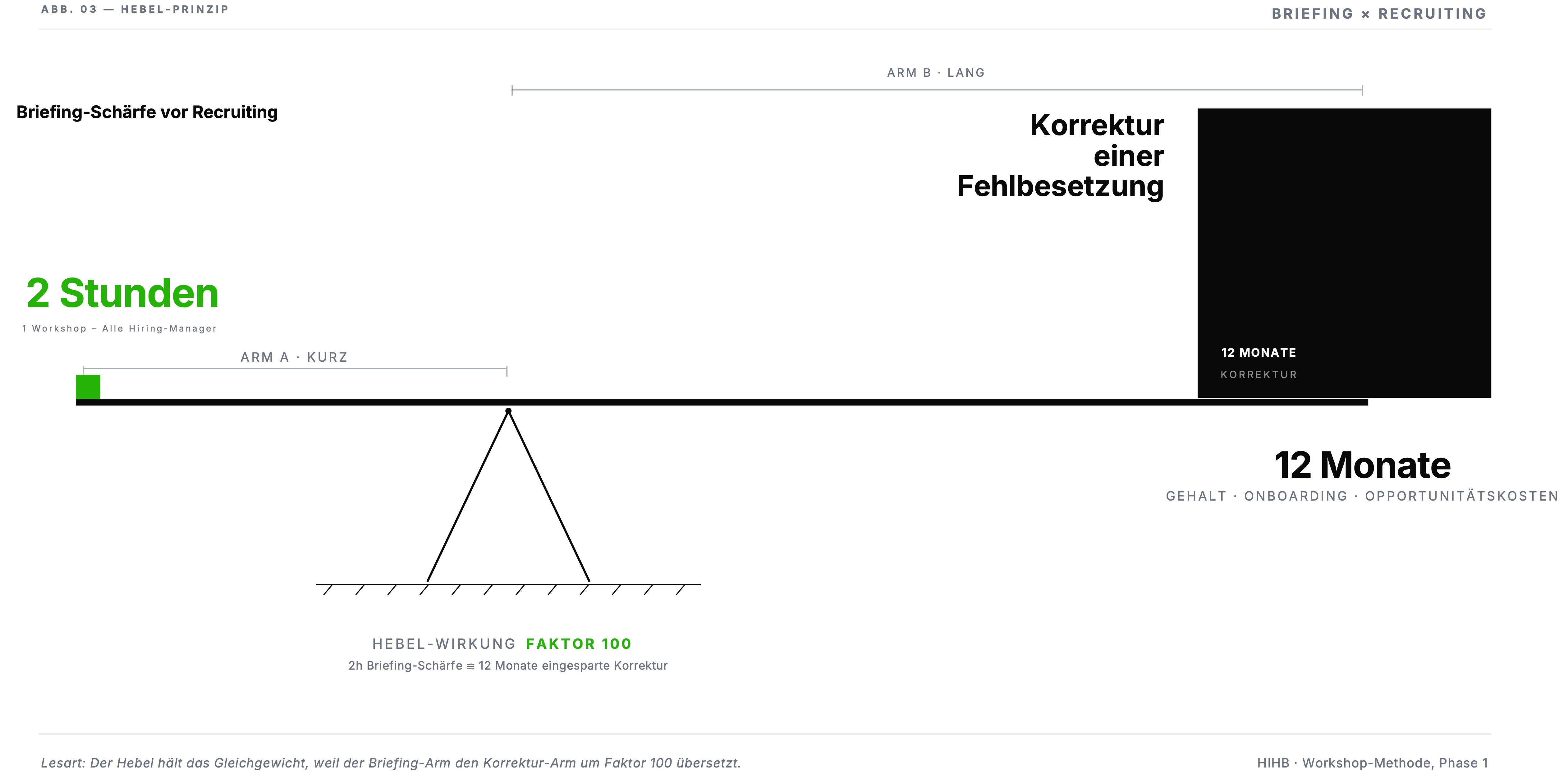
This diagnosis carries an economic consequence that is rarely calculated explicitly: the effort to sharpen a briefing before recruiting is a hundred times smaller than the effort to correct a bad hire. The correction stacks costs: customer dissatisfaction, transformation outcomes that never land, innovation that doesn't fire, team members who leave, search fees, onboarding expense, cultural damage. Combined, a multiple of the failed hire's annual salary.

2Evidence from 200+ workshops and client surveys
The data that follows comes from internal evaluations of HireWorks workshop mandates across DACH mid-market firms, family businesses, and DAX-listed boards.
… trace back to briefing gaps in retrospect, not to recruiting itself. Source: client survey 2018 to 2022 on bad hires and the difference between briefings without and with HIHB.
A frequent objection: "Why is the briefing so decisive? When you interview candidates, you find out who fits."
Without a method, interviews do generate more information. That is correct. At decision time, the estimate is roughly 50% of the relevant information on the table. At 50% you might as well flip a coin.
The inverse does not mean every such hire ends as a bad hire. It is about the risk being taken and the potential the role contains. Skipping that analysis means giving up a powerful tool: the ability to qualify candidates against those very dimensions and make an evidence-based decision.
Where are the other 90% of the information?
Most of it sits inside the hiring managers' heads. Extracting it takes the right questions, visual support, context, and experience. The facilitator matters: an outside perspective, industry experience, organisational development, and market knowledge combine into a systemic view of what success means, how it shows up in requirements, and how it can be assessed in interviews.
Even without a facilitator, applying the HIHB method (especially the 5C Method) gives recruiters substantially more quality and clarity. Critical positions get filled with greater certainty. Without it, recruiting cannot close the information gap. The consequences are extended timelines, interviews without decision readiness, and in the worst case a bad hire.
Comparison (excerpt): what job ads contain vs. what briefings actually need
| Element | Typical in job ads | Actually required for a successful hire |
|---|---|---|
| Tasks & responsibility | ✓ Standard list | ✓ + outcome definition (3-6-12 months) |
| Requirements | ✓ Hard skills | ✓ + persona (values, drive, learning agility) |
| Breakpoints | ✗ Not included | ✓ Required: what must never happen |
| Stakeholder map | ✗ Not included | ✓ Required: who decides at 6 and 12 months, against which checklist |
| 90-day plan | ✗ Not included | ✓ Required: performance measurement from day one, with transparent expectations |
| Organisational context | ✗ Not included | ✓ Required: how the organisation supports execution of the role |
This is only an extract of what a briefing can additionally capture.
An average job ad contains roughly 10% of the information relevant to a critical hire. The missing 90% is what separates a 50% one-year retention rate from a 95% one.
A 2025 Forbes piece referenced McKinsey's 2017 finding: nearly half of new executives fail within the first 18 months.1 That statistic still holds. Leadership transitions are among the riskiest moments for any organisation. And yet organisations rarely invest in the one element that moves the needle: requirements analysis and a structured briefing process.
The same article continues: "The risk is greater when leaders are hired externally, as cultural disconnects, slower trust-building, and unclear expectations amplify the challenge."1 An argument for internal promotion? Rather a clear statement: risk, context, dependencies, and potential cannot be surfaced through a single conversation. A structured process, a method, visually built, facilitated: that lifts the success rate of an external hire from 50% to above 90%.
An additional effect appears when roles are looked at not just from today's lens but with their evolution over the next years. Skills of the future can substitute parts of the must-have requirements. But only if they are described precisely beforehand.
3Five briefing failure modes
Five recurring failure modes emerge from the mandate base. They usually appear in combination - rarely is just one the problem.
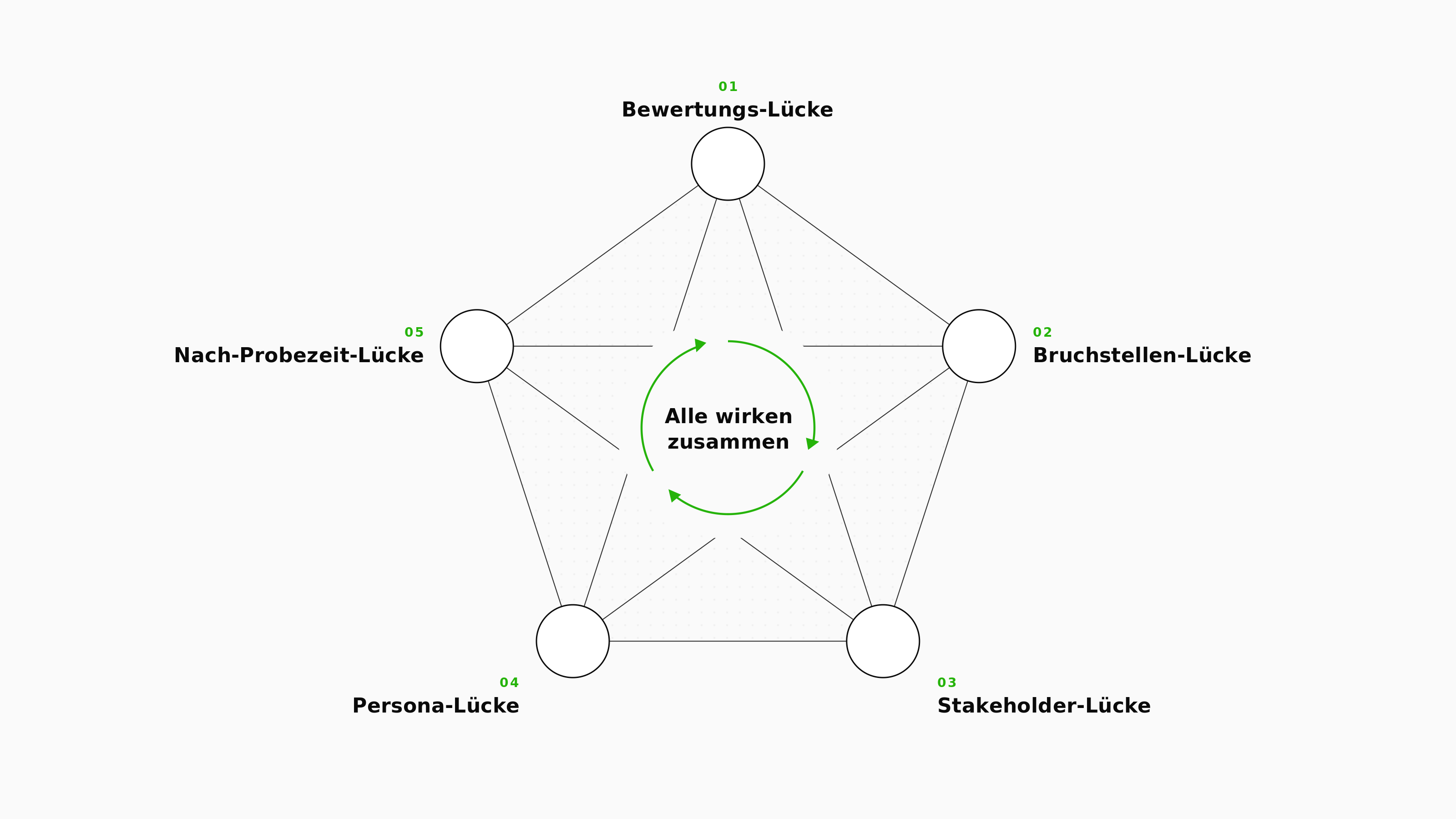
Failure mode 1: evaluator gap
It is not defined who will evaluate the person in the first months, at 6 months, and at 12 months - and against what. Result: the recruiter searches for the "ideal candidate" based on the job posting, while later performance evaluation runs on an entirely different scale. The person flunks not because they were unfit, but because the evaluation criteria were never made explicit.
Failure mode 2: breakpoint gap (risk)
The briefing describes the 80% standard role. What must absolutely not happen in this role, where are the expensive breakpoints: never defined. That is exactly where the hire fails 12 months later. Five real examples:
- "The briefing says: 'strategically strong, communicative, hands-on'. Never discussed: the role is heavily conflict-laden and requires daily hard prioritisation decisions against department heads. After 12 months, the hire fails on exactly that conflict toughness."
- "We were searching for an experienced Sales Director with SaaS experience. Not defined: the actual success factor was emotionally stabilising a chaotic sales team. Technically excellent, culturally failed after a year."
- "The job description cleanly describes the tasks. What goes unmentioned: the CEO loves spontaneous direction changes and generates high ambiguity. The new Head of Operations resigns, worn out, after ten months."
- "The briefing says 'transformation experience'. What goes unspoken: the new role-holder has to replace 30% of the leadership team. She avoids the necessary toughness and fails."
- "We were looking for an empathetic HR manager. Not defined: the role mediates heavily between an owner family and employees. The political dimension destroys fit."
Failure mode 3: stakeholder gap
In nearly every critical hire there is a person not in the hiring loop who, six months in, "buries" the role: by veto, by passive blockade, by expectations divergence. That person is always there. They are almost never identified. We call this the invisible stakeholder. In English, the term loose cannon often fits too.
Failure mode 4: persona gap
Briefings describe requirements lists: skills, experience, certifications. The underlying persona - values, life phase, motivation, conditions for high performance, learning agility, handling of errors and setbacks, risk appetite - is not defined. Result: the job ad attracts the average pool. Top candidates do not respond to requirements lists, they respond to mission and persona match. Ask yourself who the persona is that you want to win, and whether the role is a sidestep or a career step for that person. Requirements and the success scorecard follow from that answer.
Failure mode 5: post-probation gap (Flowboarding)
People analytics typically runs a dedicated programme for new hires - sensible and standard. Often it stops after probation, or the review cycles get long (three months and more). The risk: in larger organisations, leaders understand how internal politics work well enough to generate enough decoy material to land at "okay, fine, not outstanding, but not objectionable" after probation.
It also happens unintentionally when there is simply too much politics, that is, when the organisation does not effectively support the execution of the role. The critical point is not at 6 months, it is at 12 months: delays on important initiatives, latent team dissatisfaction, less revenue than expected - all directly felt.
Clarity is the key in Flowboarding too: if you take the 100% information from your briefing and align it regularly with the candidate and hiring manager over the first year, you get an honest picture of performance, possibly unrealistic expectations, organisational impediments, and unspoken goals. That is Flowboarding: a regular process to compare the detailed picture from day one with reality, and to steer accordingly.
4Three vignettes from client mandates
Three examples from the past 36 months, anonymised.
"We were looking for a Head of Operations. The briefing came from the CEO, one page, sounded complete. The HIHB Workshop surfaced this: the CFO had a completely different expectation of the role than the CEO - cost-cutting versus growth-scaling. Neither had ever discussed it with the other."
Outcome with HIHB: the workshop made the conflict visible. The briefing was rewritten with a clear outcome priority. Filled in four months. The person has been in role for 18 months, performance on plan.
"We wanted to scale product management and had planned to have the team report to a new Head of Product instead of the CEO. With several open issues in product, the requirements catalogue kept growing."
Outcome with HIHB: visually it became clear that a single role with those requirements is overloaded. The time allocation across task blocks was no longer realistic. The risk of overloading a new team lead and setting unreachable expectations was high. The role was split in two. Both were filled, both had room to operate and bring their own experience.
"We had found a candidate, but a member of the steering committee vetoed. We don't know how to work with that."
Outcome with HIHB: analysis of the position uncovered a conflict - two very different priority-one goals and missing organisational enablement for one of them. In the joint workshop, the steering committee found a solution: the role was anchored differently in the organisation, parts of the tasks were outsourced. The existing candidate could accept the offer; no new search was needed.
5What to do: three executable micro-steps
If you are defining a critical role tomorrow as a hiring manager or recruiter, three steps make a measurable difference.
Micro-step 1: the evaluator question first (15 minutes)
Before or during every briefing conversation, write down who will judge the person at 3, 6, 9, and 12 months as "successful" or "failed". List at least five concrete evaluation criteria. Describe exactly how the assessment happens and how the data is collected. Bring the assessment into the format of a scorecard. Leave room for reasoning. If you use a 1-to-5 scale, insist on target value, current rating, and a written rationale.
Bring the scorecard into the briefing first and run a review and sign-off with the hiring manager. Result: the recruiter prioritises differently, the job ad attracts different candidates, and the later performance review becomes a steering instrument. Recruiters now operate as advisors, bringing ideas and preparing decisions.
Micro-step 2: the three breakpoint sentences (15 minutes)
Sit down alone, without HR, without the recruiter. Write three (ideally five) sentences that begin with "If this person does …, the hire has failed." No platitudes, no stealing-mugs-from-the-kitchen - performance-relevant behaviour. Think the role forward as it evolves: what do you see at six months in? Bring those three sentences into the briefing first, before any task list. Result: the persona sharpens, and top candidates recognise honest self-reflection and respond differently.
Micro-step 3: the invisible stakeholder (10 minutes)
Ask yourself: "Who is disappointed or threatened if this person succeeds? Who, other than the hiring manager, benefits?" Note the first two or three names that come to mind. Schedule 30 minutes with each of them before the recruiting briefing: what do they expect concretely? Result: the briefing becomes politically realistic, not merely functionally correct.
Together, these three steps take 40 to 60 minutes before recruiting starts. They prevent a meaningful share of the briefing-caused bad hires.
6Three bridges: Forbes diagnosis and HIHB practice
The Forbes piece cited above1 describes three models intended to keep new executives from failing within the first 18 months: Leadership Trifecta, ACT Leadership, and Applied Learning Cycle. The catch: all three only activate after the person is in role.
Bridge 1: Leadership Trifecta → the 5C briefing
In the Forbes model, three skill sets are decisive: Technical Leadership (functional depth), Organizational Leadership (impact in the organisation), and Self-Leadership (the prerequisite for the other two). The mix of these three determines how a leader will perform in a specific role.
If the mix is debated only after the hire, it is too late. In the 5C briefing, it is clarified before recruiting. How much functional depth, organisational steering, and personal maturity does this specific role require? That clarity defines not only the requirements list but also the evaluation criteria for later performance reviews. An abstract Trifecta model becomes a concrete benchmark for search, selection, and onboarding.
Bridge 2: ACT Leadership → stakeholder workshop, scorecard, exposé
ACT stands for Alignment, Clarity, Trust. Forbes describes it as a duty of the leader: after stepping in, build a high-performance culture in which teams operate aligned, clear, and trust-based. The catch: a leader cannot generate ACT alone if the briefing of their own role contains no ACT foundation.
In the HIHB Workshop, ACT is built before the hire:
- Alignment: all key stakeholders are in the room. Expectations, conflicts, priorities become visible. The new leader steps into an organisation that has already aligned on a shared picture of the role.
- Clarity: scorecard and 90-day plan exist before the first offer. What success means is concretely described, not left to guesswork at day one.
- Trust: the direct-outreach exposé honestly names breakpoints, risks, and the role's enablement. Top candidates recognise self-reflection and decide on better information. Trust forms before the contract, not after.
The consequence: the leader does not have ACT as an assignment, they have it as a precondition. What Forbes describes as post-hire work accelerates from day one.
Bridge 3: Applied Learning Cycle → Flowboarding
Forbes describes a four-step learning cycle: Meaningful Goal, Deliberate Practice, Seek Feedback, Practice Reflection. Leaders who run this cycle stay adaptable in a changing world. Same trap: the cycle runs after the hire, with no upfront groundwork.
This is precisely what HIHB addresses through Flowboarding (failure mode 5):
- Meaningful Goal: defined in the briefing as outcome definition across 3, 6, and 12 months. Not abstract - concrete, tied to evaluation criteria.
- Deliberate Practice: the 90-day plan turns the first months from a soft onboarding stretch into a structured practice phase with measurable steps.
- Seek Feedback: Flowboarding has regular alignment touchpoints between candidate, hiring manager, and recruiter built into the first year. Not just at the probation line.
- Practice Reflection: structured assessment at months 6 and 12 against the scorecard defined upfront. What was correctly calibrated, what was not? What does the organisation need to support differently?
If the four steps are improvised after the hire, the learning cycle misses the leader's first nine months. If they are anchored in the briefing, learning starts on day one.
The bridge to the briefing: Forbes delivers the strategic diagnosis of why half of new leaders fail. HIHB delivers the operational answer that the diagnosis does not apply to your organisation. Not through a fourth, fifth, or sixth model - through consistent application of the three, before recruiting.
7Why the HIHB Workshop comes before recruiting
The HIHB Workshop is not a recruiting tool. It is a pre-recruiting tool. Its job: before the first offer, surface the role visually with all hiring managers and recruiting in the room, expose dependencies, make context visible, and critically interrogate risks and potential.
HIHB delivers, as output, everything you need for a successful recruiting process (apart from a good recruiter): clarity and precision, a sharper job ad, a direct-outreach exposé, an interview guide, a scorecard, onboarding and Flowboarding. Structured into two hours.
When the briefing moves from 10% to 100%, recruiting itself becomes a project with high success probability. When the briefing is not addressed, the best recruiter cannot save it.
We have seen this pattern in more than 200 mandates.
Critical hires are decided before recruiting, not during.
Frequently asked questions
Why do 90% of critical hires fail at the briefing rather than at recruiting?
Because the briefing is the information foundation recruiting builds on. If the foundation has gaps (missing evaluator definition, no breakpoints, no stakeholder map, no persona, no 90-day plan), recruiting cannot compensate. The five failure modes are statistically the dominant driver of extended time-to-fill and 12-month performance shortfalls.
What does a bad hire cost in a critical role?
Industry estimates run from 1 to 3 annual salaries, depending on role, complexity, and market position. Direct costs (search fee, onboarding, severance) are only part. Indirect costs (lost performance, cultural damage, repeat recruiting) are usually the bigger line item. A detailed mid-market calculation appears in a separate article.
What is an HIHB Workshop?
The HIHB Workshop (High-Impact Hiring Blueprint) is a two-hour format that addresses the five briefing failure modes before recruiting starts. Facilitated by an HIHB workshop leader, with all key stakeholders in one room. Output: a complete briefing with evaluator definition, breakpoints, stakeholder map, persona, and 90-day plan. More at hihb.io/en.
Can we sharpen the briefing ourselves, without external facilitation?
Yes, in theory. In practice, internal sharpening efforts fail on two points: first, political conflicts (the stakeholder gap) are rarely addressed honestly internally because every participant has a political interest in the conflict. Second, the internal setup lacks the structured method (5C Method) the HIHB Workshop provides. External facilitation is not "consulting"; it is "structuring".
Sources
- Tony Gambill, "Why Nearly Half New Leaders Fail - and 3 Models That Prevent It", Forbes, 24 June 2025. Available at: forbes.com/sites/tonygambill/2025/06/24. The McKinsey source referenced in the piece: "It really isn't about 100 days", McKinsey People & Organizational Performance Blog. ↩

Leads the HIHB methodology at HireWorks. Has facilitated workshops since 2018 with founders, management boards, recruiting teams, and hiring managers across DACH mid-market firms, large corporates, and start-ups.
Have a concrete critical role on your desk?
Fifteen minutes is enough for a first read.
We talk for 15 minutes - honest, no pitch. You leave knowing whether an HIHB Workshop pays off for you.
Book a 15-min fit call