
Critical Few: how to pull the five to eight skills that carry your strategy out of 200.
Most strategy workshops on the topic of Skills of the Future end with a pinboard full of sticky notes. Eighteen skills have emerged from the discussion, each sounds reasonable, none is wrong. What gets decided in the end is settled by a show of hands, by the weight of the loudest voice, or by the simple exhaustion of the first participant who has to leave. A strategy looks different.
HIHB Horizon is the methodological answer to exactly this pattern. The workshop is not two hours long, it is two days, with three weeks of preparation before. At the end it delivers no skill inventory, but a selection: five to eight Critical Few that no one argues about anymore, because the method has run the argument before the decision. This article describes the mechanics. It does not describe the detailed choreography - that stays inside the workshop. But it shows why HIHB systematically delivers the reduction from 200 to 5 to 8, and why a spreadsheet, a platform demo or a gut-feel consensus cannot.
1Why 5 to 8 - and not 12 or 20
The number 5 to 8 looks arbitrary. It is not. Three arguments carry it - one cognitive, one operational, one political.
Cognitive: what a board can carry
A management board can hold five to eight strategic anchors in mind and activate them in every board meeting. Beyond this limit the list falls apart into a catalogue. The Critical Few are not the capabilities HR maintains - they are the capabilities against which the CEO checks an acquisition, a site decision or a product roadmap for consistency. Anyone who runs fifteen such anchors runs none.
Operational: what a mid-market firm can invest in
Each Critical Few later pulls a build-buy-hire decision. Build means a re-skilling programme for internal profiles with a short upskilling path. Buy means an external acquisition, a licence purchase or a partnership. Hire means targeted critical hires through the HIHB Accelerator method. Practice across 200+ HIHB mandates shows: a mid-market firm with 200 to 2,000 employees cannot steer more than eight such parallel investments without overflowing the attention economy of the management board. More than eight means: none receives the energy it needs.
Political: what a triad can decide
5 to 8 force the decision triad of management, HR and business unit lead into real priorities. They force the admission that a strategy leaves something out. A list of twenty skills, by contrast, is a peace treaty: everyone finds their favourite skill, nobody has to fight. Peace treaties decide nothing. Strategy decisions need friction.
Industry reports support this mechanic from three directions. McKinsey, in its capability-building analysis, describes four critical fields where companies should build capabilities simultaneously: business understanding, strategic alignment, leadership capability, technical-functional depth. McKinsey emphasises: not the volume of skill categories, but the critical selection per field decides. Deloitte reports in its 2026 Global Human Capital Trends that 85 percent of executives rate adaptability as critical, but only 7 percent see themselves as leading. The gap arises, according to Deloitte Insights, where skill strategies deliver inventory instead of focus.1 Josh Bersin makes the point sharply in his widely cited essay on the Skills-Based Organization: skill taxonomies with tens of thousands of entries produce data maintenance, not competitiveness; the lever, he argues, is the ability to "fall in love with a problem" and derive from there what actually matters.2
The consensus of these three sources is not the exact number 5 to 8. It is the diagnosis that skill inflation remains unsuccessful in practice. HIHB sets the number at 5 to 8 because 200+ mandates show that this is the limit at which mid-market firms can deliver operationally. The method enforces this limit. The next three sections describe how.
2Phase 1: Set the strategy anchors
Phase 1 happens before the Horizon workshop. It runs for seven to fourteen days in a moderated one-to-one format between HIHB facilitation and management. Goal: to make four strategy anchors with a 24-month horizon explicit. These anchors later drive the skill selection - without them, the long list in Phase 2 has no anchor to attach to.
Anchor 1: the growth hypothesis
Where will the company generate revenue in 24 months that isn't running today? Which market, which region, which customer type. Anyone who answers this question with "we grow with our existing customers" has no growth hypothesis but a forecast. A growth hypothesis names a discontinuity. This discontinuity pulls skills.
Anchor 2: the value architecture
How will value be created in 24 months? Which steps of the value chain stay internal, which are outsourced, which are newly integrated. Anyone who decides to bring a key technology in-house instead of licensing it pulls a skill set that did not exist before. Anyone who spins off a service component gives skills away. Both decisions must sit before the skill selection.
Anchor 3: the differentiation axis
On what basis will the company win customers in 24 months against the strongest competitor? Price, speed, depth of solution, trust, regulatory expertise. It cannot be everything at once. The differentiation axis is what a board uses to test the "do we or don't we" decision in the next strategy retreat. This axis pulls specific skills.
Anchor 4: the non-negotiable risk line
What risk must under no circumstances materialise in 24 months? A compliance breach, a cybersecurity incident, reputational damage to the core business. This line is not offensive, it is defensive - and typically pulls two to three skills into the Critical Few non-negotiably, even if they don't sound "strategic".
These four anchors are not invented - they are spoken out loud. In every management team they sit somewhere, often half-explicit. The facilitation work in Phase 1 lies in putting them on the table without diplomacy. If three managing directors formulate three different growth hypotheses, that is the most valuable finding of the first phase. Without this clarification, the skill selection in later phases would be a matter of luck. With it, it becomes a consequence.
The methodological kinship with the Pre-Recruiting logic of the 5C Method is no accident here. Anyone familiar with Pre-Recruiting recognises the mechanics: first the strategy of the role, then the profile; first the strategy of the company, then the skill portfolio. What the 5C Method delivers in two hours for a critical hire, Horizon delivers in two days for the skill portfolio.
3Phase 2: Apply the evaluation filter
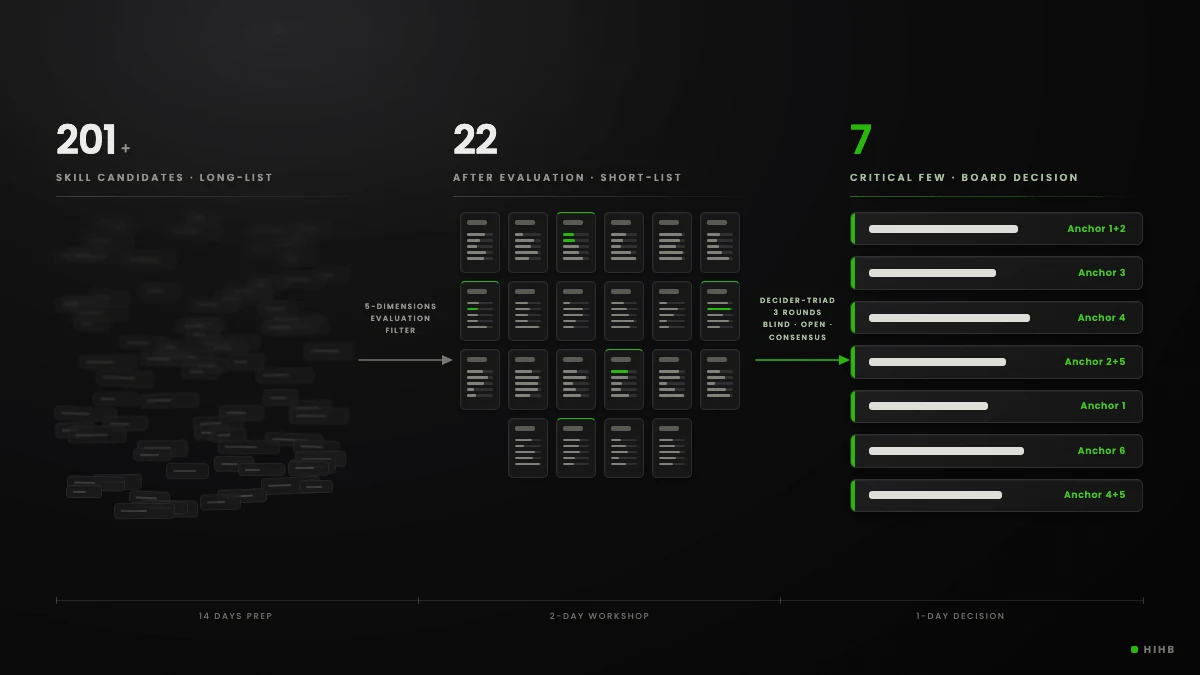
With the four strategy anchors in hand, Phase 2 runs. It is the analytical reduction: 150 to 200 possible skill candidates become roughly 20, which are further condensed in Phase 3.
How the long list comes together
The long list is not brought in by HIHB. It emerges from three sources that the company assembles before Phase 2: first, AI-assisted skill inference from its own job-ad and CV inventory (Workday, Eightfold, Lightcast, depending on licence). Second, skill market reports from the WEF Future of Jobs, the Stifterverband framework, industry-specific associations. Third, the internal voices: business unit leads, L&D, innovation owners each note ten to fifteen skills that in their view will become critical in 24 months. The result is typically 150 to 200 entries - many redundant, many too generic, a few precise.
The five evaluation dimensions
Each skill candidate is rated against five dimensions. The rating happens in a small working group (HR, strategy, one business unit lead) on a 1 to 5 scale. The score per dimension is documented transparently, not averaged - the average mean makes all skills look equally good; the disaggregated score shows conflicts.
Dimension 1 - Strategic relevance. How strongly does the skill carry at least one of the four strategy anchors from Phase 1? Skills that carry several anchors rank higher. Skills that hit no anchor drop out immediately - no matter how fashionable they sound.
Dimension 2 - Market scarcity. How difficult is the skill to source on the external labour market? Rated with available market data (DIHK skilled-worker report, industry-specific scarcity indices, recruiter experience). High scarcity raises the strategic weight, because it tips the build-buy-hire logic toward build.
Dimension 3 - Internal build effort. How long does an internal profile type need to build this skill reliably? Six months, twelve, twenty-four, more than twenty-four. Dimension 3 prevents the trap that only "sexy" skills get rated high. Some skills are strategically central but so quickly buildable internally that they do not need to be in the Critical Few - they are covered by re-skilling.
Dimension 4 - Behavioural resolvability. Can the skill be translated into observable behavioural anchors against which it can be measured in the interview, in the 90-day plan and in the performance review? "AI competence" is not resolvable. "The ability to defend a model output against subject-matter knowledge and identify hallucinations" is. Skills that are not resolvable do not make it into the Critical Few - because they cannot be steered operationally.
Dimension 5 - Role reach. How many roles in the company are affected by this skill in 24 months? Skills that only concern a single critical hire belong in the HIHB Accelerator logic - not in the Horizon Critical Few. Critical Few are skills that are portfolio-relevant, meaning they cut across multiple roles, teams or functions.
From score to a list of 20
The five dimension scores create a profile per skill - not a single index but a five-fold vector. The long list is sorted by cumulative strategic relevance (Dimension 1) and further examined from a score of 4 or 5. Skills that score high on Dimension 1 but fail Dimension 4 (behavioural resolvability) are reformulated or dropped. Skills that score low on Dimension 5 (role reach) are moved into the Accelerator inventory. What remains are 18 to 25 skill candidates - the so-called list of 20, with which Phase 3 begins.
4Phase 3: Consensus tool of the decision triad
Phase 3 is the actual HIHB differentiation tool. It happens inside the Horizon workshop - typically the second workshop day, after the four strategy anchors have been validated in plenary on day one.
Who decides
The decision triad consists of three people: management as strategy owner, HR or people leadership as the build-buy-hire mechanic, the business unit lead of the most affected functional area as operational responsibility. In mid-market firms with strong owner structures, the owner generation joins the table as well - then it becomes a quadriga. More than four makes the consensus step impossible, because the political weight of the voices can no longer be balanced.
How the decision is made - the three rounds
Phase 3 runs in three rounds. The mechanic is deliberately formal, because gut-feel voting takes the effect out of the methodology.
Round 1 - blind distribution. Each person in the triad distributes 100 points across the 20 skill candidates of the long list. The distribution is written and blind: no one sees the others' distribution before their own is complete. This mechanic prevents management from speaking first and thereby cementing the framing of the discussion.
Round 2 - open heatmap. The three distributions are transferred to a shared board. Three colours, three voices. Now it becomes visible: where is there consensus (all three give many points to the same skill), where is there conflict (one person gives 30 points, the others 0 each). The conflicts are the most valuable part of the workshop. They are not moderated away - they are voiced and traced back to the strategy anchors from Phase 1.
Round 3 - consensus reduction. On the basis of the heatmap, the list is reduced to the 5 to 8 Critical Few. Skills with consensus (all three have given points) move automatically into the Critical Few. Skills with conflict are negotiated individually: which strategy anchor carries them, which strategy hypothesis backs the scepticism, which decision resolves the conflict. At the end stand the 5 to 8 with an explicit rationale sentence per skill. No gut feel, no show of hands, no exhaustion.
Why the triad is enough
The triad is small enough to decide and large enough to have strategy, build logic and operations in the room at once. It is not representative of the whole company - that is deliberate. Critical Few are a board decision, not a participatory consensus format. Anyone who pulls more voices into the room pulls more skills onto the list. Anyone who focuses, focuses.
5Mini case: automotive supplier, 1,500 employees
The mini case is anonymised. Industry and size are accurate. A mid-market automotive supplier with 1,500 employees, three sites in southern Germany and the Czech Republic, majority family-owned in the third generation. Focus: precision components for drivetrains.
The starting point
Management had decided to trial a skills inference platform. After eight weeks of analysis the vendor delivered: 187 skill candidates that were to become "critical" in the next 24 months. The document ran 41 pages, methodologically clean, factually impressive - and not decidable in the board meeting. HR leadership was looking for a method that translates the document into a decision. Management wanted an answer before the next quarterly retreat.
Phase 1 - the four strategy anchors
In three sessions over two weeks, the four strategy anchors were made explicit. The growth hypothesis: 30 percent revenue from electrified drivetrain components, which today account for less than 5 percent. The value architecture: precision machining stays internal, control electronics are integrated via a strategic partnership instead of built internally. The differentiation axis: time-to-sample and sampling quality, not price. The non-negotiable risk line: cybersecurity in the production environment under the new UNECE requirements, with no breach.
Phase 2 - from 187 to 22
The 187 skill candidates from the AI tool were supplemented by fourteen further entries from internal business unit leads. 201 entries went into the rating. A small working group (HR lead, strategy owner, head of production) rated against the five dimensions over seven days. The result: 22 skill candidates with high strategic relevance (Dimension 1 at least 4) and sufficient behavioural resolvability (Dimension 4 at least 3). More than 80 percent of the original list dropped out - not because they were irrelevant, but because they hit no strategy anchor or could not have been steered operationally.
Phase 3 - the seven Critical Few
The decision triad met for one day with the owner generation as a fourth voice. The blind distribution in Round 1 showed: six skills had immediate consensus - all four had given them substantial points. Eleven skills were in conflict. Five skills had consensus that they were non-critical. The heatmap from Round 2 brought the conflict block into the discussion. Four of the eleven were clarified by direct reference back to the four strategy anchors - they moved into the Critical Few. Seven dropped, because no strategy hypothesis backed them. At the end stood seven Critical Few with an explicit rationale sentence:
- Embedded software architecture for drivetrain control units (Anchors 1+2)
- Cybersecurity engineering under UNECE R155/R156 (Anchor 4)
- High-precision measurement technology for electrified components (Anchor 3)
- Data-driven sampling control (Anchor 3)
- Partner integration management with Tier-1 electronics suppliers (Anchor 2)
- Functional safety engineering ISO 26262 with focus on e-drive (Anchors 1+4)
- Cross-functional product development steering in electrified programmes (Anchors 1+3)
The AI tool had listed four of these seven in its top 30. Three sat deeper in the inventory of 187 and would not have stood out at first glance without the strategy anchors. Above all, however: the board retreat six weeks later did not need the 41-page platform analysis. It needed seven sentences. The build-buy-hire decision per Critical Few was made in three and a half hours. Build for three skills (with a concrete re-skilling plan), buy for two (through the partnership with the electronics supplier), hire for two (with one HIHB Accelerator mandate per quarter).
The client's line from the debrief, six months later: "We would not have worked through the 187 skills. We would have put them aside." That is exactly the point. Critical Few are not what is left over when you cut enough. They are what you can defend.
6What to do tomorrow morning
If you owe a skill answer at your strategy retreat in the next six months, the first step does not begin with a workshop. It begins with a self-check: are your four strategy anchors for the next 24 months explicit? Growth hypothesis, value architecture, differentiation axis, non-negotiable risk line. If three members of your management team can answer each of these questions with the same sentence, you are ready for Phase 2. If not, clarifying the anchors is the most important step.
The methodology is not arbitrary. It carries only if the order is respected: first the anchors, then the rating, then the triad. Anyone who shortcuts the order - "we already know what we need, let's go straight to the triad" - ends up with eighteen skills on the pinboard and a show-of-hands vote. The method is the order, not the tools.
Three short cross-references, if you want to go deeper. Anyone who wants to understand the Critical Few logic in the context of a single critical hire reads the 5 questions before every critical hire - the mechanic there is the little sister of the Horizon mechanic here. Anyone who wants to trace the methodological origin of the HIHB reduction logic reads the 5C Method from Edition I. Anyone who wants to see the Pre-Recruiting frame before that, which puts the strategy question ahead of recruiting, reads Brief before you recruit.
And if you want to test whether Horizon fits your situation: a 30-minute call answers the question more precisely than any landing page. The workshop is not the right step for every mid-market firm. But when it is the right one, the method is worth it.
Frequently asked questions
Why exactly 5 to 8 Critical Few skills and not 12 or 20?
For three reasons. First, cognitive: a management board can hold five to eight strategic anchors in mind and activate them in decisions. Twelve fall apart into a list. Second, operational: each Critical Few later pulls a skill investment - hiring, re-skilling or buy decision. More than eight parallel investments exceed the steering capacity of a mid-market firm of 200 to 2,000 employees. Third, political: 5 to 8 force the decision triad into real priorities. 20 is a peace treaty that decides nothing.
How does HIHB Horizon differ from a Workday Skills Cloud or Eightfold?
Skills platforms like Workday, Eightfold or Gloat infer thousands of skills from CV data and project tickets. They deliver inventory, not strategy. HIHB Horizon works the other way around: first the strategy of the next 24 months, then the 5 to 8 skills that carry that strategy, only then the platform choice for operations. We do not replace a platform, we deliver the strategy filter that sits before it.
Who sits in the decision triad?
As a rule: management (strategy owner), HR or people leadership (build-buy-hire mechanics) and the business unit lead of the most affected functional area (operational responsibility). Three people, three perspectives, three voices with weight. In mid-market firms with strong owner structures, the owner generation joins as a fourth seat. More than four makes the consensus step impossible.
What happens to the 195 skills that do not become Critical Few?
They are not ignored. They move into the second-order skill inventory: relevant for operational job ads, for training curricula, for internal mobility. Critical Few are the skills for which management provides budget and attention. The rest is served by normal HR operations, not by a board decision.
Sources
- Deloitte Insights (2026): "Creating an adaptable workforce", 2026 Global Human Capital Trends. 85 percent of executives rate adaptability as critical; 7 percent see themselves as leading. Available at deloitte.com/us/en/insights/topics/talent/human-capital-trends/2026/creating-an-adaptable-workforce.html. Additional reference: Deloitte UK (2025): "Skills-Based Workforce Planning: Building a Future-Ready Workforce", deloitte.com/uk/en/services/consulting/perspectives/skills-based-workforce-planning-building-a-future-ready-workforce.html. ↑
- Bersin, Josh (2023): "Building A Skills-Based Organization: The Exciting But Sober Reality." Central thesis: skill taxonomies with tens of thousands of entries fail on data maintenance, behavioural resolution and strategic linkage; successful are programmes that "focus on a problem" and derive from there. Available at joshbersin.com/2023/07/building-a-skills-based-organization-the-exciting-but-sober-reality/. ↑
- McKinsey & Company: "Are you building employee capabilities across these four critical areas?" Four critical capability fields as a methodological scaffold for skill investments: business understanding, strategic alignment, leadership capability, technical-functional depth. Available at mckinsey.com/.../are-you-building-employee-capabilities-across-these-four-critical-areas. Complementary: McKinsey: "How European organizations can treat skills as a strategic priority" (73 percent of HR leaders claim strategic skill planning, only 12 percent actually plan on a three-year horizon).

Owns the HIHB methodology at HireWorks. Has facilitated Pre-Recruiting workshops since 2018 with management boards and hiring managers across DACH mid-market firms and large corporates. Developed HIHB Horizon with the team as the tool for strategic skill architecture before recruiting.
A strategy retreat with a skill question ahead of you:
test Horizon in a 30-minute call.
We walk through the four strategy anchors against your situation. You see immediately whether the method carries your skill portfolio - or whether a different step needs to clarify things first.
Book a 30-minute call