
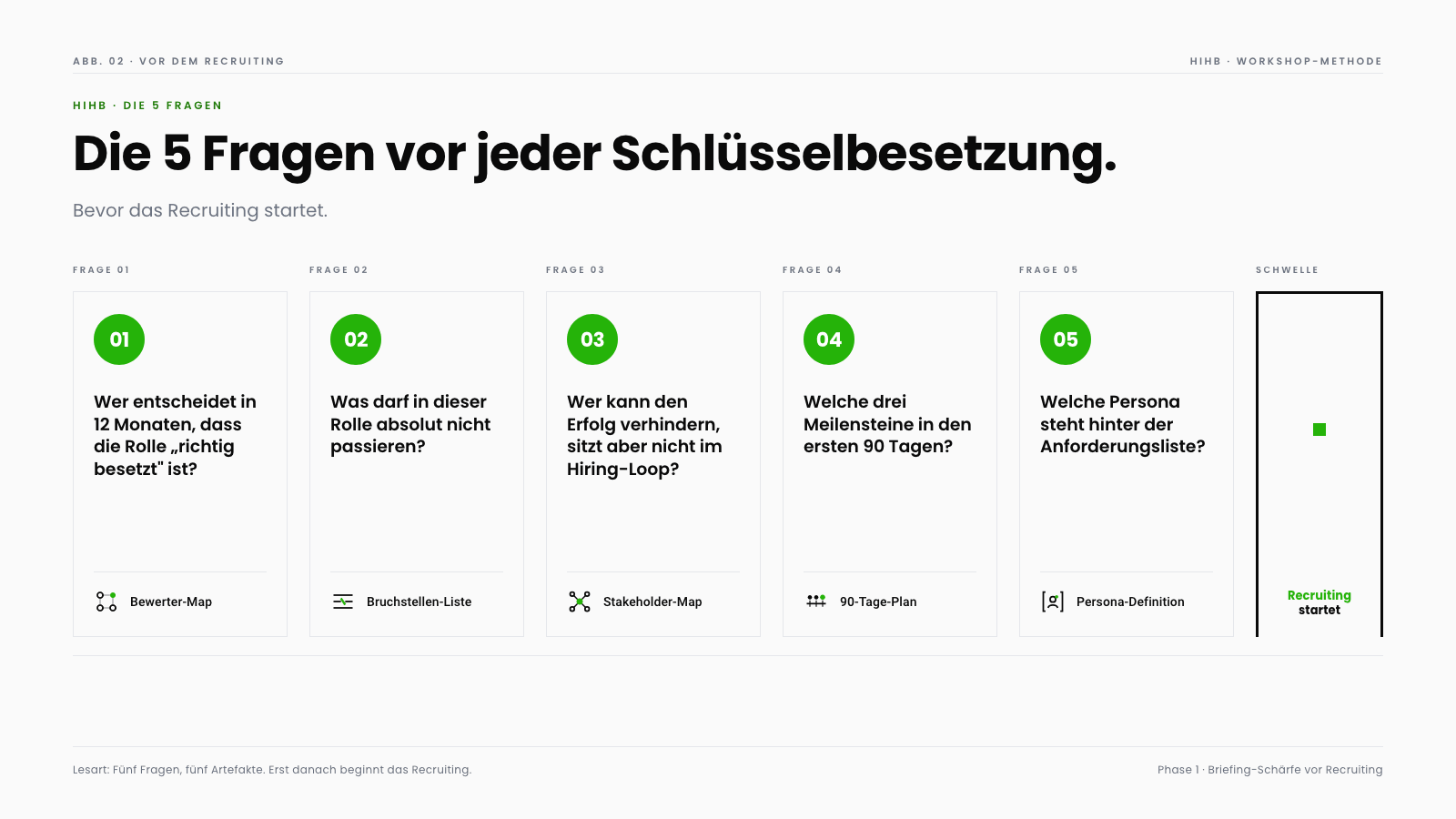
5 questions before every critical hire, before recruiting starts.
1Why these 5 questions, and not 50
Across 200+ HIHB workshops with management boards, CEOs, founders, and hiring managers, one finding keeps surfacing: critical hires rarely fail at recruiting. They fail at questions that were never asked, context that was never seen, risks and potential that were never recognised - before recruiting ever began. As a short, fast lever to improve recruiting quality and the performance of the candidate you eventually hire, run these 5 questions and work through the answers.
These five questions are not new. They are not clever. They are simply uncomfortable enough that many organisations avoid them. That is the expensive choice: briefings start with 10% of the information they actually need - standard job-ad fare. Recruiters have to shape a hire out of that gap. Sometimes it works. Often it does not.
The external data backs the finding: McKinsey reports that 40 to 50% of new executives fail within the first 18 months. Sixty-eight percent of those transitions fail because of politics, culture, and people - not technical gaps.1 The five questions are designed to surface exactly those causes.
In the next sections, we walk the five questions one by one: why each matters, how to use it concretely, and what effect you see immediately.
2Question 1: Who will decide in 12 months that this role is "filled correctly", and against exactly what?
Whoever evaluates defines the profile.
In many cases - an estimated 60% from our workshop database - the hiring manager does not know clearly enough, at the start of the briefing, who will assess the person at the 12-month mark as "successful" or "failed", and above all how. The consequence: the recruiter searches for the "ideal candidate" based on the job posting, while the later evaluation happens on an entirely different scale. The person flunks not because they were weak, but because the evaluation criteria were never made explicit.
Immediate effect: the recruiter prioritises differently. The job ad attracts different candidates. The later performance review becomes predictable.
3Question 2: What must absolutely not happen in this role?
The briefing describes the 80% standard role. The breakpoints are never defined.
Most briefings - an estimated 90% from our workshop database - describe tasks, responsibilities, and requirements, in other words the standard role. What must never happen in this role, the expensive breakpoints: that goes undefined. Another factor that pushes a hire to fail twelve months in.
Example: a Head of Marketing role has a job ad listing campaigns, budget, and team leadership. The unwritten breakpoint: "If the person builds B2C from indirect to direct without CEO backing, the hire has failed." That breakpoint appears nowhere. The recruiter searches for the classic B2C marketing profile. Six months later: conflict with the CEO, the person leaves.
Immediate effect: the persona sharpens. The recruiter prioritises differently. Top candidates recognise honest self-reflection and respond differently to the job ad.
4Question 3: Who can block this person's success over six months without sitting in the hiring loop?
In nearly every critical hire there is a person not in the hiring loop who "buries" the role six months in.
They show up in almost every constellation. They are rarely identified. Veto, passive blockade, expectations divergence: three classic manifestations. If you want to find them, you do not ask "who is in the interview loop?". You ask: "Who is disappointed or threatened if this person is successful?"
Immediate effect: the briefing becomes politically realistic, not merely functionally correct. You know the invisible success hurdle before the candidate walks through the door.
5Question 4: Which three milestones in the first 90 days show that the person will fill the role successfully?
Performance expectation gets defined in the briefing, not in onboarding.
What a person achieves in the first 90 days is, in our experience, the strongest single signal for 12-month performance. In the majority of critical hires - an estimated 80% from our workshop database - no clear 30/60/90 plan is defined before the hire. The consequence becomes visible nine months later, by which point it is too late.
Immediate effect: onboarding becomes measurable. Performance expectation gets steered. You spot bad-hire risk months earlier than before.
6Question 5: What persona sits behind the requirements list?
Critical roles cannot be captured in job ads. Requirements lists attract the average pool.
Persona definition - values, life phase, drive, learning agility, risk appetite - opens the candidate pool that requirements lists close. Top candidates do not react to skill lists, they react to mission and persona match.
Immediate effect: the job ad attracts different candidates. Recruiter direct outreach becomes targeted. You reach people who do not respond to standard postings.
7Application: 30 minutes before the next briefing
The five questions are designed so you can walk them in 30 minutes before any briefing conversation. If two or more remain unanswered, you have a briefing problem, not a hiring problem. That is the point at which an HIHB Workshop pays off. For the strategic backdrop - why hiring belongs on the board's attention list - see our Edition VI article „Strategy or People?".
The detailed PDF version with cover, accompanying questions per item, and CTA is available as the Executive Letter. You can share the letter directly in a hiring conversation; many hiring managers use it to prepare the briefing with their stakeholders.
Sources
- Scott Keller, Mary Meaney, "Successfully transitioning to new leadership roles", McKinsey & Company, Organization Practice, May 2018. Available at: mckinsey.com/.../successfully-transitioning-to-new-leadership-roles. Key figures: 27 to 46% of executive transitions are rated two years later as a failure or disappointment; 68% of transitions fail because of politics, culture, and people. The 40 to 50% rate in the first 18-month window: Scott Keller et al., "It really isn't about 100 days", McKinsey, November 2017. ↩
Frequently asked questions
What are the 5 most important questions before every critical hire?
1. Who decides that the role is "filled correctly"? 2. What must not happen - the breakpoints? 3. Who is the invisible stakeholder that could block success? 4. Which 90-day milestones show that the person will own the role? 5. What persona sits behind the requirements list? These five questions were distilled from 200+ HIHB workshops and address the recurring failure modes of critical hires.
How long does it take to answer the 5 questions before a briefing?
About 30 minutes alone, plus a 30-minute stakeholder conversation (Question 3). Compare that to the effort of a bad hire: 12 months of lost performance, a new recruiting cycle, repeat onboarding investment. The effort leverage is at least 1:50.
Are the 5 questions enough, or do we still need an HIHB Workshop?
For clear, well-bounded roles with a clean stakeholder constellation: yes, the 5 questions often suffice. For complex critical roles with political complexity, multiple hiring managers, or profiles that cannot be advertised cleanly: no. The workshop enables structured co-clarification in one room, which the 5 questions alone cannot deliver.

Leads the HIHB methodology at HireWorks. Has facilitated workshops since 2018 with founders, management boards, recruiting teams, and hiring managers across DACH mid-market firms, large corporates, and start-ups.
Have a concrete critical role on your desk?
Fifteen minutes is enough for a first read.
If two or more questions stay open, we talk for 15 minutes - honest, no pitch. You leave knowing whether an HIHB Workshop pays off for your next critical role, or why not.
Book a 15-min fit call