
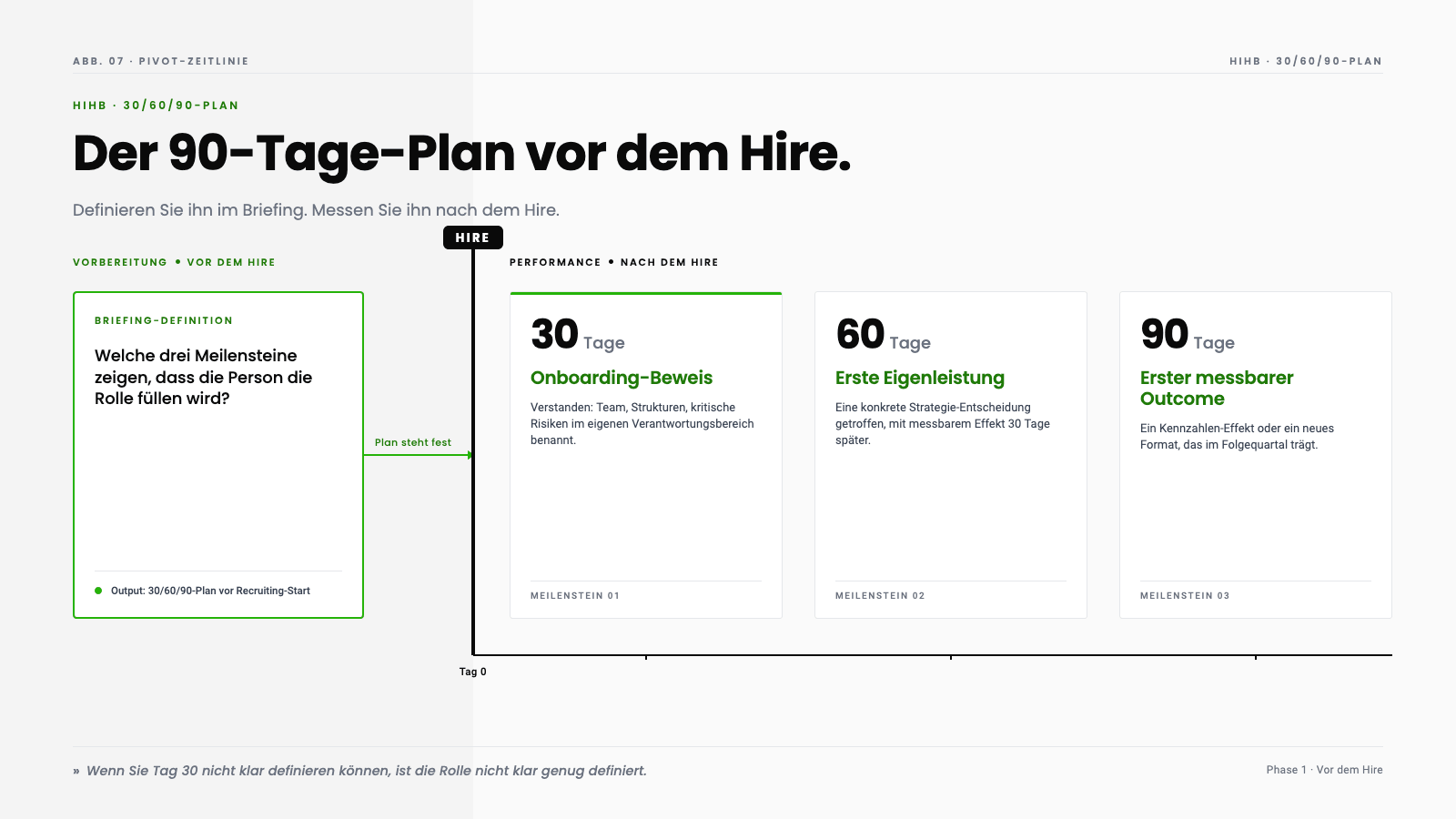
The 90-day plan before the hire - performance expectation gets defined in the briefing.
1The thesis: 90 days decide 12 months
What a person achieves in the first 90 days of a critical role is a strong signal for their 12-month performance. Stronger than CV match, stronger than interview impression, stronger than references. The finding has a name: Michael Watkins, "The First 90 Days" (Harvard Business Review Press), has shown for more than two decades that the transition phase decides later impact.1
Across 200+ HIHB workshops we see the same pattern consistently: when the day-30 milestone is met, most people move cleanly through to day 90. When it is missed, the 12-month performance expectation tips in a large share of cases. The day-30 mark is the practically usable breakpoint.
2Why the plan belongs in the briefing, not in onboarding
The most common mistake: 30/60/90 plans get formulated after the hire, in onboarding, with the person already on board. That is too late, for three reasons:
- Expectation drift: when the person is already there, 90-day expectations get unconsciously adjusted to fit them. The plan no longer measures the role, it measures the person.
- Stakeholder differences stay hidden: in the briefing phase, the hiring manager, CFO, and direct line manager would have to formulate their different expectations and align on them. In onboarding, usually only the direct line manager speaks.
- The job description loses focus: if day 30 is only defined after the hire, neither the recruiter nor the candidate knew during the hiring process what performance measurement would be.
Consequence: many critical roles start without a clear 30/60/90 plan. Nine months in, it becomes visible that performance does not match. By then it is too late.
3The 30/60/90 template
Three milestones, each with a concrete success criterion. Example for a Head of Sales (mid-market firm):
| Day | Milestone | Success criterion |
|---|---|---|
| Day 30 | Onboarding proof | All 12 sales team members spoken to individually, top-3 account structures understood, three material pipeline risks named |
| Day 60 | First independent contribution | One concrete strategy decision taken (pipeline prioritisation, team reorg, account reallocation), with measurable effect after 30 days |
| Day 90 | First measurable outcome | Pipeline conversion in a prioritised segment measurably improved, or a new sales format established that takes effect in Q4 |
Format rule: every milestone must be describable in one sentence. If you need more words, the milestone is too vague.
4Application in the recruiting process
The 30/60/90 plan is formulated in the HIHB Workshop in step C-4 (Coordination), together with the persona definition. It then flows into three concrete points of the recruiting process:
- Recruiting briefing: the plan is part of the recruiter-internal briefing. The recruiter searches deliberately for people for whom the 90-day milestones appear reachable.
- Final interview: the plan is shown to the final candidate, with the question: "What do you think is realistic? Where do you see risks?"
- Contract signing: the plan becomes part of the written success expectation, not as a legal clause, but as a shared understanding.
5Early-warning system when day 30 is missed
The key operational advantage of the 30/60/90 plan: it acts as an early-warning system. If day 30 is not met, that is not "bad luck", it is a signal that has to be taken seriously.
Four response options, in this order:
- Diagnosis: are the milestones formulated too ambitiously, or is there a performance issue?
- Resource check: does the person have the structures, mandate, and support to deliver?
- Expectation sharpening: was day 30 communicated clearly enough to the person? If not, reformulate and adjust day 60.
- Consequence: if diagnosis, resources, and expectation are all sound and day 30 is still missed, that is a clear signal that will, at the latest, force a decision at day 90.
6Bridge: Watkins' "The First 90 Days" and HIHB
Michael Watkins coined the concept of the "Breakeven Point" in "The First 90 Days" (Harvard Business Review Press): the point at which a new leader creates more value for the organisation than they cost in onboarding effort.1 The book has been the reference for executive onboarding since 2003, translated into 24 languages, with more than a million copies sold.
Watkins addresses the new leader: how they structure the first 90 days, build relationships, secure early wins. HIHB addresses the organisation filling the role: how it defines the plan before the hire, so the new leader knows from day one what day 30, 60, and 90 will be measured against.
The three Watkins concepts clarified up front in the HIHB briefing:
- STARS diagnosis (Start-up, Turnaround, Accelerated Growth, Realignment, Sustaining Success): in which situation does the role start? In HIHB, located in 5C step C-1 (Contingency). Anyone searching without this clarification writes a job ad for a task that, in that form, does not exist.
- Early wins: Watkins stresses that the first 90 days must generate visibility. In HIHB, that is the day-60 milestone, "first independent contribution", binding in the briefing.
- Securing yourself: Watkins asks the new leader to secure resources and mandate. In HIHB, that is the enablement check in the briefing: can the organisation actually deliver what the role requires?
The consequence: whoever reads "The First 90 Days" and then hires without prior definition hands the full risk - including the cost of a likely second-chance correction after 90 days - to the new leader. Whoever clarifies the three concepts before recruiting halves the risk before the first job ad goes live.
Frequently asked questions
What is a 30/60/90-day plan in recruiting?
A 30/60/90-day plan defines three concrete milestones for a new position: onboarding proof (day 30), first independent contribution (day 60), first measurable outcome (day 90). The plan is defined before the hire in the briefing, not later in onboarding.
Why does the 90-day plan belong in the briefing and not in onboarding?
Because the briefing phase is the only phase in which stakeholders discuss performance expectations before they get influenced by a concrete person. In onboarding, the expectations get retro-fitted to the person who has already been hired.
What should a 90-day plan for a critical role look like?
Three concrete milestones, each describable in one sentence: day 30 (onboarding proof), day 60 (first independent contribution), day 90 (first measurable outcome). If you cannot define day 30 clearly, the role is not clear enough.
Sources
- Michael D. Watkins, "The First 90 Days: Proven Strategies for Getting Up to Speed Faster and Smarter", Updated and Expanded Edition, Harvard Business Review Press, 2013. ISBN 978-1-4221-8861-3. Available at: store.hbr.org/product/the-first-90-days. ↩

Leads the HIHB methodology at HireWorks. Has facilitated workshops since 2018 with founders, management boards, recruiting teams, and hiring managers across DACH mid-market firms, large corporates, and start-ups.
Have a concrete critical role on your desk?
Fifteen minutes is enough for a first read.
In 15 minutes, we formulate the first 30/60/90 milestones for your next critical hire - you see immediately where the briefing is sharp or fuzzy.
Book a 15-min fit call