
How to build a role scorecard for a key hire
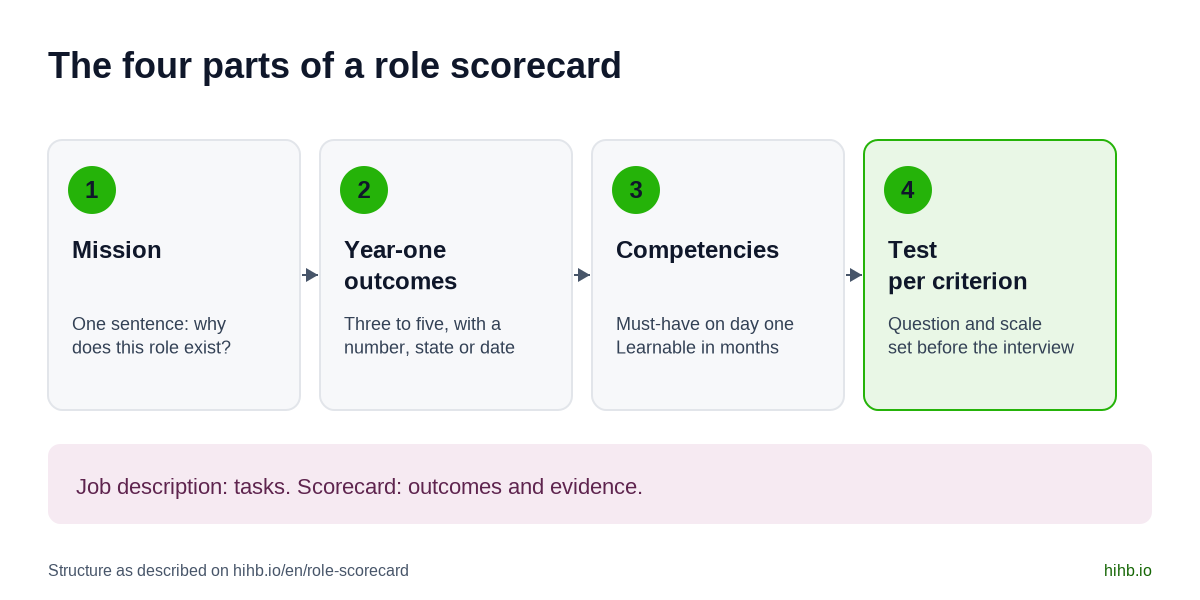
You build a role scorecard for a key hire in four parts: the role's mission in one sentence, three to five measurable outcomes for the first year, the competencies split into must-haves and what can be learned, and for each criterion the question you'll use to test it in the interview.
This page gives you the structure, a template you can copy, a filled-in example and the most common mistakes. At the end you'll see how HIHB (High-Impact Hiring Blueprint) derives the building blocks of a scorecard from the answers of the people involved.
What a role scorecard is
A role scorecard describes how you'll know, a year from now, that the hire worked. It isn't a job description. A job description lists tasks; a scorecard names outcomes and the evidence you look for during selection.
That makes it the shared yardstick for everyone involved in the hire. Every interviewer tests the same criteria. Whoever decides compares candidates on the same points.
Template
Copy the table into your own document. One row per outcome or competency.
| Part | What goes in | Your entry |
|---|---|---|
| Mission | One sentence: why does this role exist? | |
| Outcome 1 | What is achieved after twelve months, and how is it measured? | |
| Outcome 2 | ||
| Outcome 3 | ||
| Competency (must-have) | What the person must be able to do from day one | |
| Competency (can be learned) | What they can learn in the first few months | |
| Context | Team, scope of decisions, deal-breakers | |
| Test per criterion | Which question or task tests it in the interview? | |
| Rating | Scale 1 to 4, with a description of what 1 and 4 mean |
Example: Head of Sales at a 120-person company
A made-up example to make the parts concrete.
| Part | Entry |
|---|---|
| Mission | Take sales over from the founder and build it so it grows without him. |
| Outcome 1 | After twelve months, at least 60 percent of new business no longer comes through the founder's contacts. |
| Outcome 2 | A sales process with defined stages is in place and kept up to date in the CRM. |
| Outcome 3 | Two sales roles are filled and onboarded. |
| Competency (must-have) | Has built a staged sales process before, not just run one. |
| Competency (can be learned) | Knowledge of the industry and the products. |
| Context | Reports to the managing director, owns a budget, the founder keeps three key accounts. |
| Test | "Tell me about a sales team you built. What did it look like on day one, and after a year?" |
How to go about it
- Start with the mission. One sentence on why the role exists. If the people involved can't agree here, the next steps aren't worth it yet.
- Outcomes, not tasks. Ask: twelve months from now, how will you know it was the right person? Every outcome needs a number, a state or a date.
- Separate must-haves from what can be learned. Cut every competency that doesn't feed an outcome. Split what's left into must-have and can-be-learned.
- One test question per criterion. A criterion only becomes testable in the interview once it has a question. Agree beforehand what a weak and a strong answer sound like.
- Get everyone to sign off. Hiring manager, team and leadership read the scorecard before the job ad is written, not after the third interview.
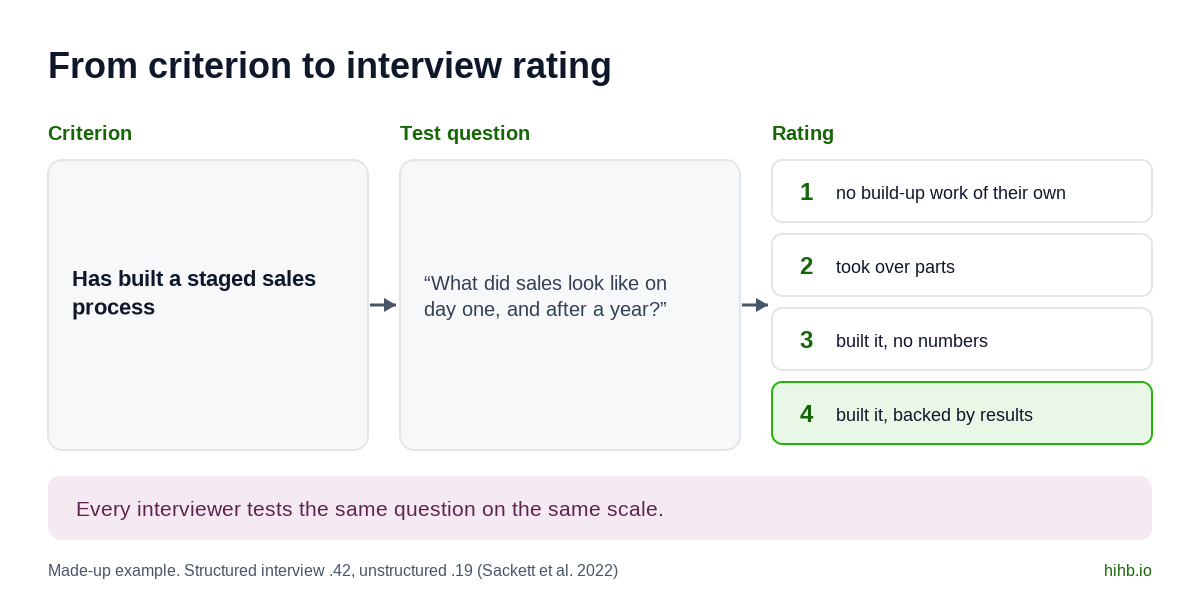
The effort pays off in selection. A structured interview with criteria set in advance predicts job performance far better than an unstructured conversation (Sackett et al. 2022: .42 versus .19). More in the article on which hiring methods predict job performance.
Common mistakes
- The scorecard is a renamed job description. It lists tasks but not a single outcome.
- Everything is a must-have. Twenty equally important requirements describe a person who doesn't exist.
- Criteria without a test. "Strong communicator" is in there, but nobody knows how to spot it in an interview.
- One person writes it alone. The differences between hiring manager and team then only show up with the candidates.
How the HIHB app derives the building blocks of a scorecard
HIHB - the role clarity app for key hires. Recruiting sets up a session for the role and hands it to the people involved. Every answer is kept as a card with a label and an author; the Context Engine connects the cards and flags contradictions. In the second part of the session, the 5C method guides through five steps (C1 to C5).
At the end there is a blueprint of the role. It contains the first-year success criteria and the interview questions, the building blocks of a role scorecard, plus the job ad and sourcing channels from the same answers.
The app prepares. In the personal interview, a person decides.
Frequently asked questions
What's the difference between a role scorecard and a job description?
A job description lists tasks. A role scorecard names the outcomes expected after a year, and how you test in the interview whether someone can deliver them.
How many outcomes should a scorecard have?
Three to five. You can't test more than that properly in one selection process.
Who should work on the scorecard?
The hiring manager, the future team and, for key roles, leadership. Recording each view separately shows where the pictures of the role differ.
When do you build the scorecard?
Before the job ad. Then the ad, the interview questions and the rating all come from the same source.
Does the scorecard replace the interview?
No. It sets what the interview tests. Decisions about people stay with people.
What does HIHB cost?
Packages and prices are listed on hihb.io under pricing. You decide after the first finished blueprint, not before.
Read on
- The 5C method
- not the checklist
- Which hiring methods predict job performance?
- The method at a glance
- Bias starts before the search
- How HIHB is built
- More questions: software to define a key role, role clarity app, hiring manager intake meeting
You decide after the first finished blueprint, not before.
Request access