
Hire the person, not the checklist: how to double your candidate pool.
1The problem with requirements lists
A typical job ad for a critical role lists five to eight bullet points under "Requirements": skills, years of experience, industry background, certifications. The list filters objectively: anyone with X years, Y industry, and Z certification qualifies. Anyone without is out.
The problem is not the list itself. The problem is what it filters. Requirements lists attract the average pool. Candidates who match every point on paper, and that is exactly what they do: match. Top candidates, the ones who would make the difference in the role, often do not score 100 percent because their career was less conventional or they come from a different industry - including the strong internal candidates a talent pool would surface.
2What a persona means in recruiting
A persona describes who the person is, not what they can do. While the requirements list enumerates skills, the persona captures values, life stage, drive, and risk appetite in four to six sentences. It does not replace the list. It adds the dimension that skills cannot capture.
Example persona for a critical "Head of Sales" role (mid-market firm, 350 employees):
"She is 38 to 45 years old, has spent the last 10 years in two mid-market B2B sales organisations, and has shaped a phase of strategic change in both. She is now looking for a role where she can make the jump from operational sales to strategic build-out - not as a career step, but as an identity step. Risk appetite: medium; she will not join an early-stage start-up but is drawn to the change-resilience of the mid-market. Definition of success: in 24 months, to have built a sales team that functions without her in the room."
This persona is subjective. It is formulated by stakeholders in the briefing workshop, not derived from a database. It is still precise enough for a recruiter to search against.
3Seven persona dimensions that matter
| Dimension | Question |
|---|---|
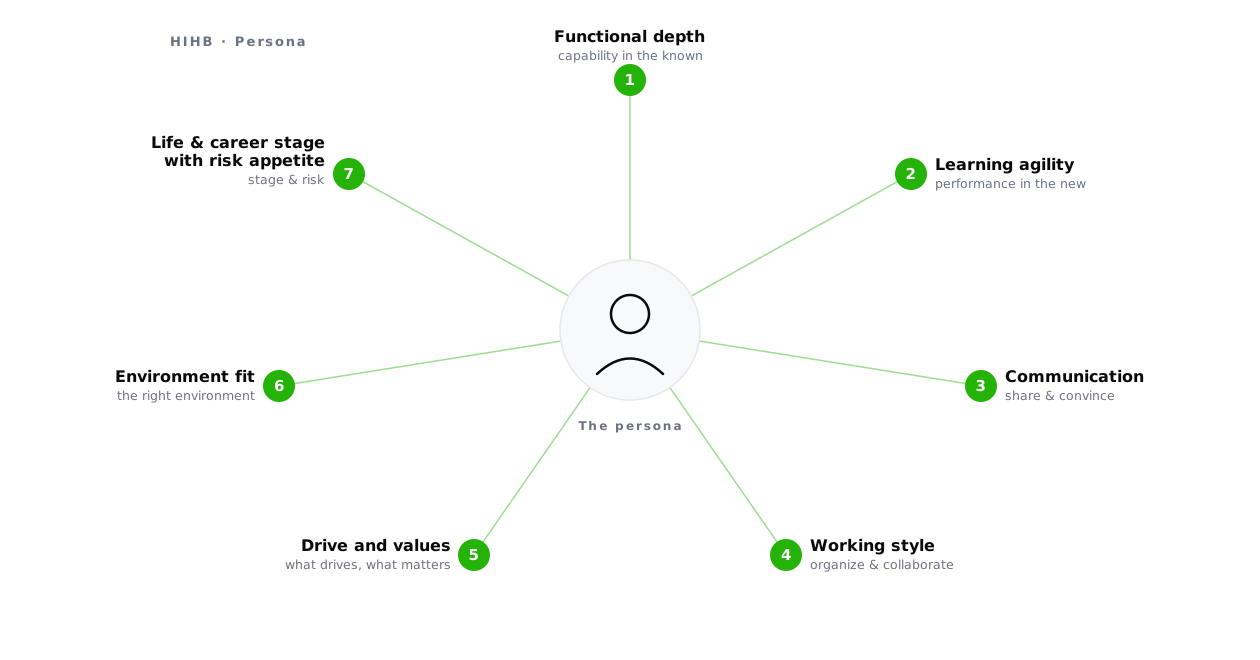
| Functional depth | Is the functional background there, and to what degree? |
| Learning agility | How is learning anchored? What did the person learn from mistakes, and when did they not? |
| Communication | How do they communicate praise, criticism, mistakes (others' and their own), new insights, and a why? |
| Way of working | How do they handle ad-hoc requests? How do they sequence tasks and goals by order and priority? Which formats do they use for productive collaboration? |
| Drive and values | What moves this person for the long run, which values will they not give up, and what does success mean to them? |
| Environment fit | Which culture, leadership and team constellation does the person need to be effective? (the precise replacement for cultural fit) |
| Life and career stage with risk appetite | Where is the person biographically, and how much security or risk are they looking for right now? |
These seven dimensions are deliberately non-overlapping: each addresses a distinct source of mis-hire, none repeats another. They describe the person, not the role. What the role itself is measured by belongs in the briefing, not the persona. That keeps the persona the yardstick for who carries the role, without sliding into the cultural-fit trap.
4Application: persona in 20 minutes
Persona definition is step C-4 of the HIHB 5C Method (Coordination). In the workshop, it is formulated in 20 minutes, with the following flow:
- 5 min brainstorm per stakeholder: each person writes three sentences on the persona, no discussion.
- 10 min consolidation: the sentences are placed side by side, differences are discussed, a shared persona description in four to six sentences is agreed.
- 5 min validation: test questions: "Would you recognise this person if they walked into the first interview? Would they be a clear yes for you?"
Output: a persona description that feeds into the recruiting briefing and gives recruiter direct outreach a concrete search logic.
5Impact: doubling the pool in practice
The core effect of persona definition: recruiters search differently. Instead of a requirements-match search ("LinkedIn profiles with skill X, Y, Z"), it becomes a persona-match search ("Who, at which life stage, with what drive, would make this the right move?"). That opens the pool in two directions:
- Industry cross-over: people from adjacent industries with a persona match become relevant - the ones a requirements list would have filtered out.
- Career breaks: people with unconventional careers who would not "fit" the list but are exactly right by persona match.
Empirically, across 200+ HIHB workshops we typically see the relevant candidate pool double after persona definition. Not because more candidates exist, but because more of them become visible.
This pool opening aligns with broader research on skills-based hiring. McKinsey, in an analysis of skills-based workforce strategy, finds that hiring on skills is five times more predictive of later job performance than hiring on formal education, and more than twice as effective as hiring on work experience.1 An accompanying LinkedIn analysis adds that the relevant talent pool opens up by nearly a factor of 19 when organisations evaluate candidates by skills rather than by titles or degrees.1
Persona definition is the HIHB translation of this logic into the language of the hiring manager. Instead of building a skill taxonomy, the persona describes the person who will carry those skills. The result is the same: the pool opens because the exclusion criteria from the CV fall away.
Frequently asked questions
What is the difference between a requirements list and a persona in recruiting?
A requirements list describes what the person must be able to do (skills, experience, certifications). A persona describes who the person is (drive and values, communication, working style, environment fit, life and career stage). Requirements lists are objectively verifiable, but they attract the average pool. Personas are subjective, but they open the pool that lists close. Top candidates respond to mission and persona match, not to skill lists.
How do you define a persona for a critical role?
In four to six sentences, not as a bullet list. The persona covers seven dimensions: functional depth, learning agility, communication, working style, drive and values, environment fit, and life and career stage with risk appetite. What the role itself is measured by belongs in the briefing, not the persona. The persona description is the bridge between hiring manager briefing and recruiter direct outreach.
How does a persona definition widen the candidate pool?
Requirements lists filter candidates by formal criteria. A persona filters by mission fit. The result: you screen out fewer candidates who do not match 100 percent on paper but are the right person by persona match. Empirically, we see the relevant pool double. McKinsey research on skills-based hiring points in the same direction: up to a 19-fold pool expansion when skills are evaluated instead of titles or degrees.
Sources
- McKinsey & Company, "Taking a skills-based approach to building the future workforce", McKinsey People & Organizational Performance, 2022. Available at: mckinsey.com/our-insights/taking-a-skills-based-approach. The LinkedIn figure on a 19-fold pool expansion is referenced within this McKinsey publication. ↩

Leads the HIHB methodology at HireWorks. Has facilitated workshops since 2018 with founders, management boards, recruiting teams, and hiring managers across DACH mid-market firms, large corporates, and start-ups.
A critical role on your desk?
Fifteen minutes of persona sparring.
In 15 minutes we sketch a first persona for your next critical hire. You see whether the method holds.
Book a 15-min fit call