
Hiring manager intake meeting: agenda and questions
A good hiring manager intake meeting has five parts: why the role is being filled and what it's for, the outcomes for the first year, must-haves versus what can be learned, context and selection process, and finally the open points with an owner. It takes 45 to 60 minutes and ends with a written summary the hiring manager signs off.
This page gives you the agenda, the questions most intake meetings miss, and a way to run it without a shared slot.
Why the intake meeting gets squeezed
The intake meeting is where recruiting learns what the role really demands. In practice it happens between two other meetings. The hiring manager has ten minutes, last year's job ad is on the table, and what's left at the end is an almost empty form.
You see the consequences later. The ad lists tasks instead of outcomes, candidates are judged against different yardsticks, and after the third interview it turns out someone else has a say who wasn't in the intake.
The agenda in five parts
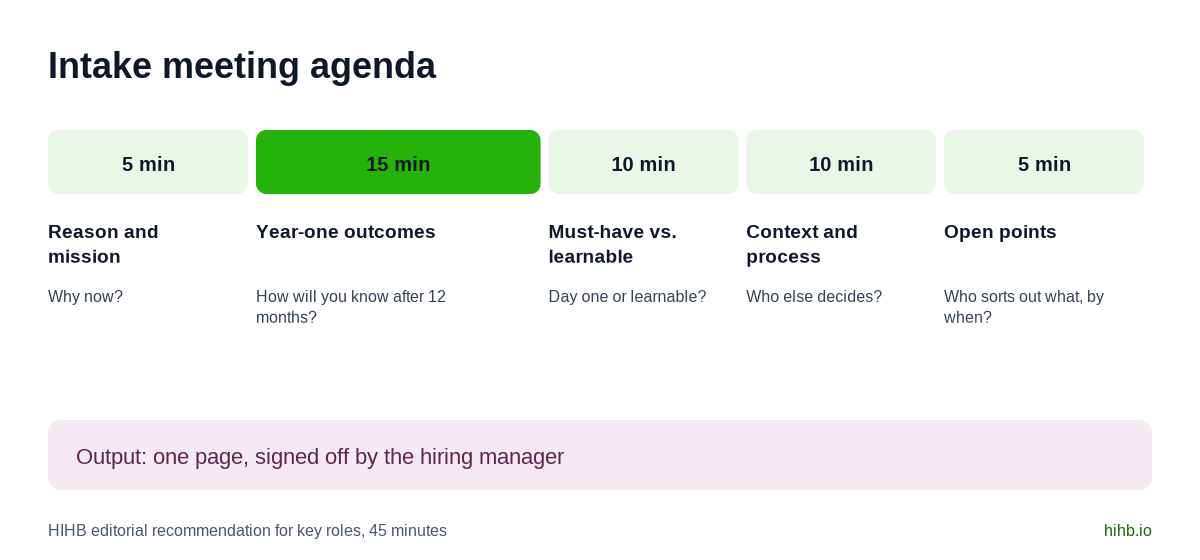
| Part | Time | Guiding question |
|---|---|---|
| 1. Reason and mission | 5 min | Why is the role being filled now, and what is it for? |
| 2. Year-one outcomes | 15 min | Twelve months from now, how will you know it was the right person? |
| 3. Must-haves vs. learnable | 10 min | What must they do from day one, and what can they learn? |
| 4. Context and process | 10 min | Who do they work with, who else decides, what does selection look like? |
| 5. Open points | 5 min | What do we still need to sort out, by when, and who owns it? |
The questions most intake meetings miss
- "What does this person do that no job ad mentions?" The answer shows the part of the role the old ad doesn't know about.
- "Why didn't it work out last time?" Only if the role was filled before. The answer names the criterion that was missing.
- "Who else has to say yes at the end?" Anyone who decides but isn't in the intake brings their criteria in at the final round.
- "What would make you turn down someone who's strong on paper?" This surfaces unspoken expectations about how people work together.
- "Why would the right person want this role?" Without an answer, the ad has no reason for anyone to apply.
How to prepare the intake meeting
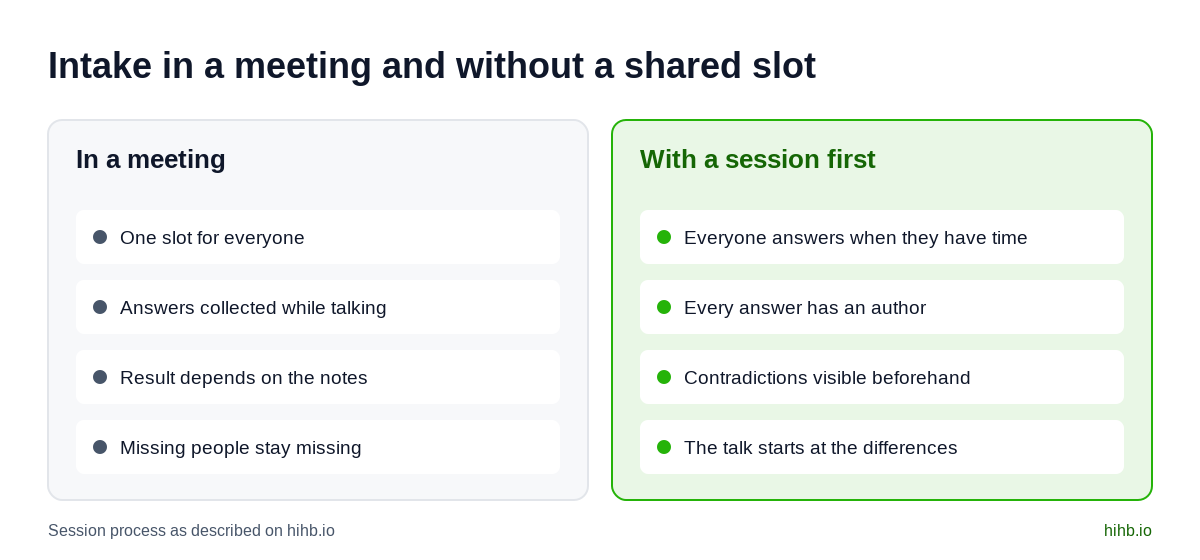
- Ask in writing first. Send the guiding questions two days ahead. The meeting is then for discussion, not collection.
- Hear everyone involved. If the team or leadership has a say, get their view separately. Differences show up before the search, not after.
- Follow up on vague answers. "Team player" or "someone with drive" is a start. Ask what the person actually does for that, week by week.
- Get the summary signed off. Put mission, outcomes and criteria on one page. The hiring manager confirms it before the ad is written.
Without a shared slot: how the HIHB app works
HIHB - the role clarity app for key hires. Recruiting sets up a session for the role and hands it to the hiring manager and others involved. They answer in the browser when they have time, and can pause and pick up later.
The Context Engine keeps every answer as a card with a label and an author, connects the cards and flags contradictions. In the second part of the session, the 5C method guides through five steps (C1 to C5), down to the one insight into why the right person should want this role. At the end there is a blueprint of the role: job ad, sourcing channels, interview questions and first-year success criteria.
Recruiting sees what has been added and can start the conversation where the answers diverge.
The app prepares. In the personal interview, a person decides.
Frequently asked questions
How long should an intake meeting take?
45 to 60 minutes for a key role. If the guiding questions are answered in writing beforehand, the meeting itself can be shorter.
Who should attend the intake meeting?
Recruiting and the hiring manager. Anyone who decides later should be heard beforehand, in the meeting or in writing.
What's the output of an intake meeting?
One page with the mission, first-year outcomes, must-haves and learnables, the selection process and open points. The hiring manager signs it off.
What if the hiring manager has no time?
Send the questions in writing, or set up a session in a role clarity app. The conversation then gets shorter and sharper.
Does the app replace the intake meeting?
No. It replaces the shared slot as the only chance to talk. The conversation starts where the answers diverge.
What does HIHB cost?
Packages and prices are listed on hihb.io under pricing. You decide after the first finished blueprint, not before.
Read on
- Hiring manager enablement
- The invisible stakeholder
- Brief before you recruit
- State of Hiring Briefings 2026
- The method at a glance
- The 5C method
- Bias starts before the search
- How HIHB is built
- More questions: software to define a key role, role clarity app, how to build a role scorecard
You decide after the first finished blueprint, not before.
Request access