
Why 800-skill databases fail - and what the Critical Few deliver instead.
1The scene: twelve thousand skills, one board question
The meeting sits on the calendar as "Workday Skills Cloud demo - HR Director, CFO, IT". The sales rep presents a platform that has inferred close to twelve thousand skills from two hundred CVs. Clusters, adjacencies, trend curves. A heatmap pulses on the slide. The HR Director nods, the CFO does the maths in his head against a three-year active-sourcing budget. At the end of the demo she asks the only question that counts in this room.
"Which ten of them carry our strategy?"
Silence. The rep falls back on "Talent Intelligence workflows" and "inferred adjacency models". The HR Director repeats the question. The meeting ends politely. Three weeks later the company signs the licence anyway - not because the answer came, but because nobody has a better one.
The scene has been repeating itself in the DACH mid-market for around two years in the same form. Workday, Cornerstone, Beamery, Eightfold and Gloat sell skills platforms with a similar promise. The demo is good. The implementation costs six figures. And the board question stays open.
This article describes why that is - with verified data from Josh Bersin, the Sevoir Group and Deloitte. And it describes what the Critical Few logic of the HIHB method delivers instead: not cataloguing eight hundred skills, but identifying the five to eight on which the next 24 months actually hang.
- Josh Bersin, 2023
Bersin's sentence is not meant ironically. It is descriptive. The promise is real. The only question is whether the platforms deliver on it.
2What the platforms promise
The skills-tech landscape has split into four camps since 2020. Each camp promises to solve the skill problem, and each one solves it from a different direction.
Camp one: the ERP aggregators
Workday, SAP SuccessFactors and Oracle build their skills clouds on the existing HRIS data foundation. They infer skills from job titles, performance reviews and training histories. Advantage: the data is already in the system. Disadvantage: the data describes the past, not the strategic future. Bersin classifies them as "the least sophisticated" layer, which ultimately becomes "skills aggregators with APIs" sitting between more specialised systems.
Camp two: the recruiting platforms
Eightfold, Beamery, Phenom, Seekout and iCims index billions of worker profiles from outside the company. They infer skills through time-series models and neural networks. Advantage: deep data across industries and job families. Disadvantage: the inference works backwards from the CV, not forwards from the strategy. Anyone searching for "AI literacy 2027" finds 2024 Java developers here.
Camp three: the talent marketplaces
Gloat, Fuel50 and Hitch concentrate on internal movement. They match employees to projects and gigs, often through skill adjacencies. Advantage: usable for internal mobility programmes. Disadvantage: the model ends at the company boundary, and the adjacency model is an aid, not a strategy.
Camp four: the learning platforms
Cornerstone, Degreed and EdCast read skills out of learning content. They match learning paths to competence gaps. Advantage: direct link to the L&D budget. Disadvantage: a skill gets reduced to a course list, not to a strategic position within the company.
What all four camps share is a database logic: the more skills captured, the better. Lightcast, one of the most important data suppliers in the industry, runs a dynamic skills library with "tens to hundreds of thousands of skills", as Bersin documents. Workday Skills Cloud, Cornerstone and Beamery work with taxonomies that in practice quickly cover eight hundred entries or more per function. That is not a bug, that is the model. The assumption behind it: if we just keep tagging long enough, data volume will turn into strategic clarity.
Following that assumption costs mid-market companies between 80,000 and 400,000 euros in annual licence fees, plus implementation effort of twelve to twenty-four months. The data is in the next sections.
3Three failure modes of the 800-skill logic
The Sevoir Group, a British workforce consultancy, published what is probably the most precise public finding on failed skill taxonomies in 2025. Daniel Jurow describes in the piece "Why Organizations Fail at Skills Intelligence" why "skills taxonomy projects frequently fail, leaving expensive platforms running on bad data or sitting unused".1 The three most common failure modes can be cleanly isolated.
Failure mode 1: data maintenance collapses
A skill taxonomy is not a static document. It is a living system that has to pull skills out of job descriptions, project plans, training material, onboarding decks, software manuals and LinkedIn profiles - and out of the knowledge sitting in individual heads, condensed into job titles. The Sevoir Group describes the reality: "Where does the information about your roles, tasks, workflows, and competencies live exactly? Not one place, is typically the answer."
In companies with multiple sites or live M&A integration, the effort multiplies with regional, cultural and functional nuances. In practice this means: after eighteen months of curation, the HR team has either burnt through the budget or the data is so fragmentary that the platform produces suggestions nobody takes seriously anymore.
Failure mode 2: the level of detail misses the target
"HR teams are happy to purchase generic skills databases so broad that they do not reflect the company's true team model. Department insiders try to write their own but tend to get so granular they're unusable", Jurow writes. The two paths fail for opposing reasons at the same point: neither hits the strategy level.
HR lists are too broad because they buy in skills from industry taxonomies that do not match the company's actual value creation. Function-led lists are too narrow because they specify skills at tool level ("operating a specific designer function") instead of at capability level ("design-led decision-making"). Both camps miss the level at which the board question "which skills carry the strategy" would be answerable.
Failure mode 3: adoption never happens
Even if taxonomy and platform run technically, the data work only takes effect when managers profile their teams in the platform and employees maintain their profiles. The Sevoir Group describes the typical pattern: "Managers don't reference the data because it's incomplete, and they don't end up providing assignment and development opportunities based on the insights. Employees stop updating profiles because no one seems to use them."
That is not an adoption problem in the narrow sense. It is a meaning problem. A skill profile that changes no decision for anyone is experienced as an administrative burden - and quietly switched off after three quarters, without anyone formally closing the project.
Deloitte delivers the quantitative confirmation. In the study "The skills-based organization: A new operating model for work and the workforce", 85 percent of HR executives say they have skill-taxonomy efforts under way. But only ten percent consider their classification effective.2 That is the gap in which platform licences get written off.
85 percent of HR leaders have skill-taxonomy efforts under way. Only ten percent say they actually classify skills effectively and organise them in a taxonomy. The gap between effort and effectiveness is the gap into which platform investments disappear.2
4Bersin's "sober reality"
In July 2023 Josh Bersin, one of the most influential analysts in the HR-tech world, published an article titled "Building A Skills-Based Organization: The Exciting But Sober Reality". The text is not an anti-platform pamphlet. Bersin himself sells tools in the Galileo ecosystem that move in this direction. But he describes with unusual clarity where most skills programmes fail.
The core of his argument concerns the definition of skill itself. Most platforms treat skills like technical proficiencies - programming languages, tool knowledge, methodological know-how. But Bersin quotes his former IBM manager: "Hard skills are soft - it's the soft skills that are hard." The skills that actually carry a company are often the ones hardest to tag: learning agility, judgement, conflict capability, cultural fit.
He references a Harvard study by Boris Groysburg, which showed that even top-rated investment bankers often lose their performance edge when they change employers. Their "skills" were never just technical skills - they were the organisational knowledge, the relationship networks, the understanding of unwritten rules. A skills cloud that reduces these skills to their technical shell misunderstands the problem.
Bersin's second finding: companies that work with skill taxonomies typically take one of two paths. Path one - the skill-taxonomy team builds a comprehensive classification and negotiates it across all functions. This path "has many points of failure" and often takes so long that the original assumptions are out of date before the model goes live. Path two - the company identifies a concrete business problem and builds the taxonomy around that problem. Bersin calls this "falling in love with the problem" and explicitly recommends it.
- Josh Bersin, 2023
The HIHB method has been working to exactly this logic since 2018. We do not build a comprehensive skill map for an entire company. In a workshop we identify five to eight skills on which a concrete strategic undertaking depends - a critical hire, a re-skilling initiative, a market expansion. That is no less ambitious. It is the only practicable sequence.
Bersin closes with a sentence that sums up the whole industry: "We have yet to find a company that uses one platform for everything." The "single skills cloud" - the main selling point of the ERP world - is, five years into market maturity, still a hypothesis, not a documented state.
5What the Critical Few logic delivers instead
Critical Few is not a marketing term. It is a methodological position that has condensed out of 200+ HIHB mandates and is derived systematically in the HIHB Horizon workshop. The logic differs from the 800-skill database at three points.
First: reduction before capture
The platform logic starts with capture - tag as many skills as possible, then sort. The Critical Few logic starts with reduction: which strategic objectives sit on the table for the next 24 months, and which capability decides whether the company delivers them? The question forces board and function leadership into a trade-off discussion before any tag lands in a database. That is uncomfortable, but methodically decisive - the discussion happens anyway, the only question is whether before or after the six-figure licence investment.
Second: behavioural anchors instead of skill labels
A skill in a database is a string. "Strategic decision-making capability" sits in the entry, and the platform infers from past job titles who possesses it. The HIHB approach resolves the same skill into observable behaviour: how does someone with this capability act in a trade-off situation, in a stakeholder conflict, in a decision under uncertainty? The behavioural anchor is what can be tested in an interview, measured in a 90-day plan, and assessed in a performance review. The string cannot. The follow-up Edition VIII article on behavioural-anchor methodology goes deeper into this mechanic.
Third: strategy coupling instead of database consistency
An 800-skill database is optimised for internal consistency - every skill has a definition, an adjacency, a learning unit. The Critical Few method is optimised for strategic coupling - each of the five to eight skills hangs directly on a strategic objective that board and function leadership have explicitly named. If the strategic objective shifts, the skill shifts. A database cannot deliver that coupling, because it knows nothing of strategy. It can only catalogue skills.
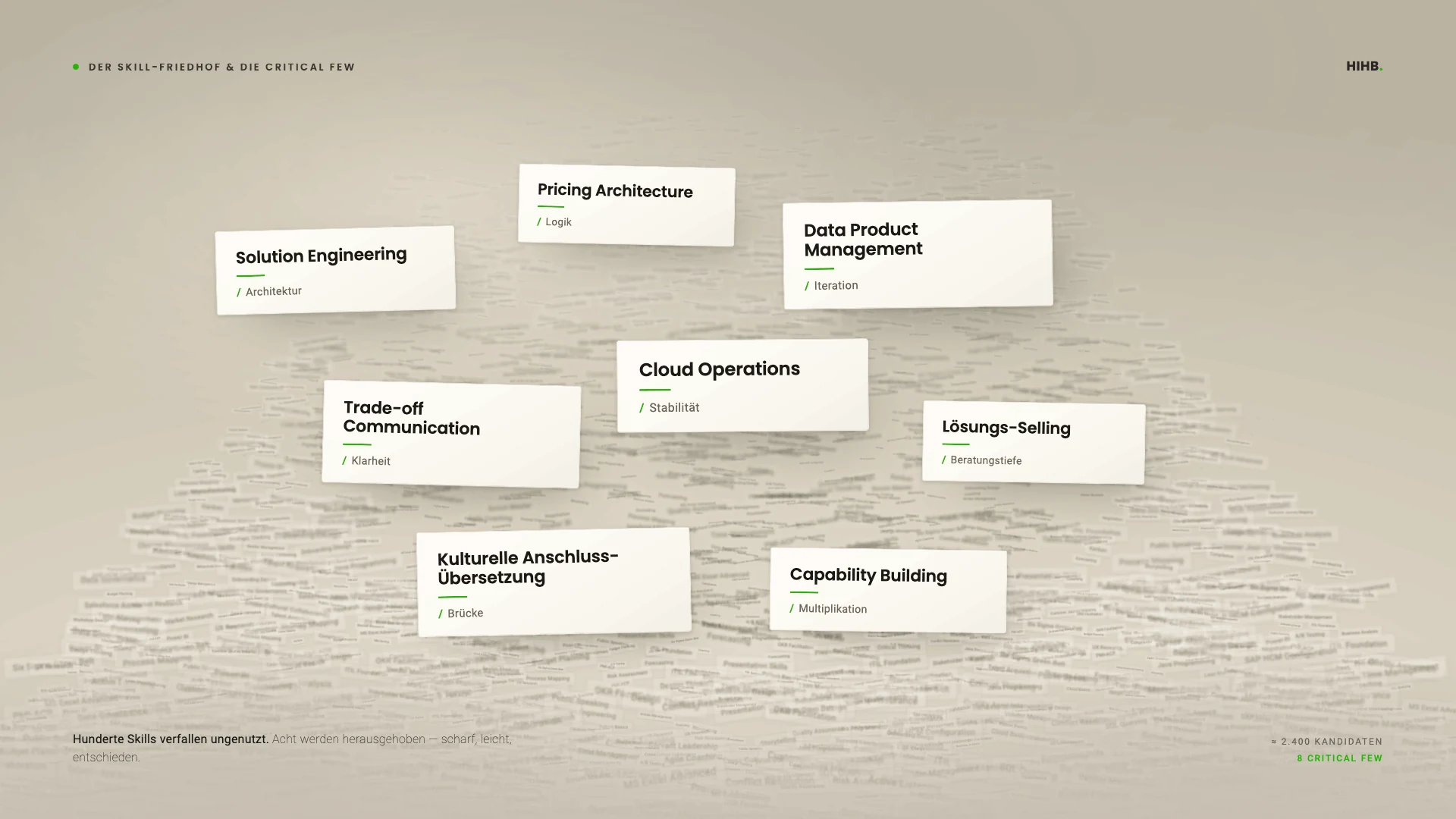
In HIHB practice that looks like this: a mid-market engineering firm is planning the move into data-driven services for 2027. Three strategic objectives sit on the table - build a cloud platform, develop a pricing model for SaaS, retrain the sales force on solution selling. From the three objectives, a two-day workshop isolates seven Critical Few skills: solution engineering, pricing architecture, data product management, trade-off communication, cloud operations, solution selling, cultural translation. Not 800. Not 80. Seven. Each with a behavioural anchor, each with a build/buy/hire decision, each with a named tier-1 and tier-2 neighbourhood inside the company.
The result is not a platform file but a strategic decision. It fits on one page and survives the next board offsite, because it does not come from a model but from a discussion with the people who own the strategy.
The Critical Few logic is methodologically related to the 5C Method of HIHB Pre-Recruiting, which HIHB has applied in over 200 mandates since 2018. In both cases the point is the methodological reduction to what actually carries the decision - in 5C the critical hire, in Critical Few the skill strategy. Both procedures are the answer to the same observation: anyone who wants to be complete at the start is no longer decision-capable at the end.
6Decision in the mid-market: buy or design?
For CHROs and managing directors in the mid-market, the question in practice is rarely "platform or no platform". It is a sequencing question: which step comes first, and which follows - if at all?
Three scenarios show how the sequencing typically diverges.
Scenario one: platform first, question later
A 600-employee company signs a skills-cloud licence after a convincing demo. Implementation takes fourteen months. After completion, 4,200 skills sit in the system. The board question "which carry our strategy" goes unanswered, because the platform does not ask it. After a further twelve months, the HR team is "not actively maintaining" the platform - polite code for adoption death. The budget is written off, the licence runs on.
By Sevoir Group's observation, this is the most common pattern. "Skills taxonomy projects frequently fail, leaving expensive platforms running on bad data or sitting unused."
Scenario two: question first, then potentially a platform
The same company runs a Horizon workshop before the platform decision. In two days, six Critical Few skills are isolated, described with behavioural anchors, coupled to the strategy for the next 24 months. The HR Director walks into the next platform conversation with a clear question: "What can your platform deliver for these six skills - with which data foundation, which inference logic, which maintenance load?" The conversation is no longer led by the platform but by the company. Frequent outcome: the platform is bought smaller than offered, or not at all.
Scenario three: Critical Few instead of platform
For many mid-market companies a skills cloud is simply over-dimensioned. Six Critical Few skills with behavioural anchors, a neighbourhood map and a build/buy/hire decision deliver enough to underpin the next 24 months of strategy methodically. A six-figure licence solves no problem that would be unsolvable without it - it only adds complexity and maintenance load. The platform decision moves two or three years back, with a clearer picture of what it is actually supposed to deliver.
Sequencing is the actual point. Anyone who answers the strategy question before the platform question buys differently. Anyone who buys the platform before the strategy still has the strategy question open at the end.
This logic is not anti-platform. It is only uncompromising on the assumption that database size replaces strategic clarity. The fundamental scepticism towards platform promises in recruiting has established itself in the skill world over the last three years - the lines of argument largely overlap with the HIHB-versus-AI-recruiting comparison and with the observation that skill-based hiring without strategic anchoring produces the same failure modes as an 800-skill database. We read the movement as methodological maturation, not as anti-tech reflex.
7What to do next
If a skills-cloud offer is currently sitting on your desk - Workday, Cornerstone, Beamery, Eightfold, Gloat or Lightcast - three steps are worth taking before the signature goes on the licence.
Step 1: make the board question explicit
Take an hour with the management board and ask in writing: "Which five to eight capabilities carry our strategy in the next 24 months?" The answer will be fuzzy. That is not the problem - that is the evidence. A platform that does not answer this question is not the answer.
Step 2: three strategic objectives on the table
Write down the three strategic objectives by which your company will be measured in the next 24 months. Per objective: which capability decides whether you deliver? That is the long list from which the Critical Few emerge. If the list grows longer than twenty skills, it is not ripe for the platform question. It is ripe for a methodological reduction - facilitated internally or in the Horizon workshop.
Step 3: check the platform demo against the Critical Few
Once the Critical Few are in place, take them into the next platform demo. Do not ask the vendor question "what can your platform do". Ask the buyer question: "What does your platform deliver for these six skills - with which data foundation, with which maintenance load, with which adoption mechanic?" You will receive more precise answers, see smaller configurations and get more honest pricing. Often also: the realisation that the platform is over-dimensioned for this purpose.
The Critical Few logic is not an anti-platform argument. It is a sequencing argument. Bersin puts it like this: "This work is part of a bigger shift, away from rigidly defined jobs to roles focused on work. It's ok to take the time to do this carefully. It's ok to set up governance, experiment with different tools, and fall in love with the problem one step at a time."
Eight hundred skills are not a strategy inventory. They are a data-maintenance assignment. Strategy is the five to eight on which the next 24 months hang.
Frequently asked questions
Why do 800-skill databases fail in the majority of implementations?
Three points collapse with regularity: data maintenance (nobody curates 800 entries consistently), behavioural resolution (a skill label without observable behaviour stays a buzzword) and strategic anchoring (no mechanism that turns the 800 into the five that actually carry the strategy). Josh Bersin speaks in 2023 of the "sober reality", Sevoir Group documents the failure modes in detail, Deloitte shows: only 10% of HR leaders consider their own skill classification effective.
What are Critical Few skills?
Critical Few skills are the five to eight capabilities that actually carry the strategy of the next 24 months. They do not emerge from a catalogue, but from three steps: surface strategic objectives, prioritise skills, make behaviour concrete. The HIHB method deliberately works with this reduction, because 50 or 500 or 800 skills delay the decision rather than accelerate it.
Are skills platforms like Workday, Cornerstone or Beamery pointless?
No. The platforms deliver database work that HIHB does not replace. But they also do not replace strategy work. Anyone who does not know the Critical Few beforehand buys a skills cloud that infers 12,000 entries and has no answer to the board question "which skills carry our strategy?". Sequence: Critical Few first, then potentially a platform for operations.
How does a mid-market company choose between platform purchase and proprietary methodology?
For mid-market companies in the 200 to 2,000 employee range, the skills-cloud licence is often the most expensive answer to the smallest question. Before a six-figure licence is signed, the strategy question should be answered methodically: which five to eight skills carry the next 24 months? The HIHB Horizon workshop delivers this answer in two to three days - without HR data leaving the company.
Sources
- Sevoir Group Associates, "Why Organizations Fail at Skills Intelligence (and Why It Matters)", Daniel Jurow, 2025. Available at: sevoirgroup.com/blog/skills-taxonomies. ↩
- Deloitte Insights, "The skills-based organization: A new operating model for work and the workforce", Sue Cantrell, Michael Griffiths et al. Finding: 85% of HR leaders have skill-taxonomy efforts under way, only 10% consider their own classification effective. Available at: deloitte.com/us/en/insights/topics/talent/organizational-skill-based-hiring. ↩
- Josh Bersin, "Building A Skills-Based Organization: The Exciting But Sober Reality", 8 July 2023. Core thesis of the "sober reality": no single platform covers the skills architecture of an entire company today; successful skill programmes start from a concrete problem, not from a comprehensive taxonomy. Available at: joshbersin.com. ↩

Leads the HIHB methodology at HireWorks. Has facilitated workshops since 2018 with founders, management boards, recruiting teams, and hiring managers across DACH mid-market firms, large corporates, and start-ups. Developed the HIHB Horizon skill-architecture method for strategic capability decisions.
A skills-cloud decision on the table?
15 minutes is enough for an honest read.
We talk for 15 minutes, no pitch. You leave knowing whether the platform decision is ripe - or whether a Horizon workshop should clarify the Critical Few first. Cross-service: HIHB Horizon on hireworks.de.
Book a 15-min fit call