
Skill neighborhood - why skill lists hide your reskilling opportunity.
1The invisible skill neighborhood
A CHRO of a mid-market mechanical-engineering firm, 1,400 employees, calls in March. The management board signed off five Critical-Few skills for the next 24 months at the February strategy retreat. Top of the list: data storytelling. The strategy demands that production, sales and service units can build their own data narratives, not just read dashboards.
Three weeks later the CHRO sits in the pre-meeting with the board. On the table: a letter from a specialised executive search firm. Two senior data storytellers, target salary above 180,000 euros each, six to nine months time-to-hire, both fought over in the market. The supervisory board asks: "Did we really have to start externally?" The CHRO has no answer. Inside the company sit 1,400 people. No one knows how many of them could close in on the new role with six months of upskilling. No one has ever drawn the map.
This scene repeats itself in every second Horizon mandate we have moderated in the past twelve months. The finding is always the same. The Critical-Few list is in place, properly prioritised, five to eight skills, all fine. What is missing is the second step. Who inside is close to those skills? Who is reachable with reasonable effort? Who sits outside the internal range and needs to be sourced externally? The answer to these three questions is called skill neighborhood (in English: skill adjacency). It is the underrated logic in Pre-Recruiting.
ManpowerGroup surveyed 39,000 employers in 41 countries for its 2026 Talent Shortage study. 72 percent report they cannot fill critical roles. For the first time, AI skills lead the list of hard-to-fill capabilities - AI model and application development at 27 percent, AI literacy at 26 percent.1 Boards read these numbers as an argument for aggressive external recruiting. In reality, they are an argument for the opposite path. When the external market is empty, the internal skill neighborhood becomes the strategic lever - not the emergency exit.
This article describes what skill adjacency is methodically, why the mid-market systematically overlooks the logic, how HIHB Horizon produces a neighborhood map with an inner and outer ring for each Critical-Few skill, how this turns into a Build/Buy/Hire decision - and what value that lifts for a mid-market company. It picks up where our piece on internal mobility as a recruiting strategy left off, which describes the tenure data. Skill neighborhood is the methodical bracket around it.
2What skill adjacency is, methodically
Skill adjacency is not a new buzzword. In the workforce-analytics world the logic has been established for more than ten years, first academically, now industrially. Lightcast (formerly Burning Glass) operates what is probably the largest publicly documented skill-gap data model. In Lightcast's Career Pathways API, each occupation carries a vector of more than 32,000 individual skills. Between two occupations the model calculates a directed skill gap: which skills must a person additionally learn to move from occupation A to occupation B, and what weight does each of these skills carry in the target occupation.2
The model is directed. The path from Scrum Master to Agile Coach is not the same as the path from Agile Coach back to Scrum Master. The database breaks this asymmetry effect down into individual skill differences and emits an importance score for each difference, indicating how central the difference is for the target occupation.
This mechanic answers three questions that stay open without the model:
- Who is close? Which current profiles overlap with the target skill on at least 60 to 70 percent of their skill vectors?
- Which difference carries the weight? Which three to five additional skills decide a successful transition, and which are secondary?
- How long is the path? What upskilling effort emerges when the difference skills must not only be learned but also anchored behaviourally?
Gartner has consolidated this logic in its workforce-transformation reports over the past two years. The term skills adjacencies appears there regularly, embedded in a dynamic skills approach: instead of forecasting skill needs over the long term, leading organisations identify secondary and tertiary skills on which the core skills build, and use skills accelerators - existing content, people and skill adjacencies - to develop solutions faster.3 The logic is not polemical, it is strategic: less guessing, more bridging.
The decisive point for Pre-Recruiting methodology lies not in the database, but in the methodical question. Skill adjacency translates the abstract concept Critical Few into a concrete people-movement hypothesis. Instead of saying we need twelve data storytellers, the methodical question reads: which of today's profiles are three skill differences away from the target skill, which seven, and at what difference does the external path start paying off?
Anyone who knows our pillar piece on Skills of the Future sees the arc: the pillar defines the Critical-Few logic, this article shows the next question. Without an adjacency map the Critical-Few list stays a list. With an adjacency map it becomes a decision basis.
A second methodical note is important, because it often gets lost in market discourse: skill adjacency is not a pure algorithm question. Anyone using the Lightcast API without moderated workshop logic gets a proximity calculation at the occupation level, not at the person level. The algorithmic answer says: Scrum Master is close to Agile Coach. It does not say: your Scrum Master Ms Krueger is close because she has been guiding two teams in parallel for two years, won the employee-development award, and is already at the third level in workshop format X. That second resolution comes only from facilitation, in which business-unit leaders feed their own observations into the map. The algorithm is the prerequisite, the map is the decision.
3Why the mid-market overlooks it
DAX-40-class corporations have introduced skills platforms over the past five years - Workday Skills Cloud, Eightfold AI, Gloat. Whoever sits there has a skill inventory, repeatedly validated, with semantic inference from CVs and job postings. In the mid-market the picture is different. Three structural reasons why skill neighborhood is systematically overlooked.
First: the HR-tech infrastructure is missing.
A mid-market company with 800 to 2,000 employees rarely runs its own skills cloud. The HR-software landscape often consists of a personnel-master system, an applicant-tracking system and a learning platform - three systems that talk to one another via first-name-last-name, not via skill vectors. The investment in semantic skill inference is hard to justify economically: licence costs start above 250,000 euros per year, implementation takes twelve to 24 months, the strategy effect at mid-market scale is unproven.
The result is a systematic asymmetry: the methodical logic is available in the market, the corporate uses it, the mid-market firm stands next to it without a tool. This is precisely where the manual methodology comes in - one that does not replace a 250,000-euro tool but answers the methodical question in a moderated session.
Second: the methodology that works without a tool is missing.
Whoever does not run a skills cloud needs a different mechanic. In the mid-market the skill question is usually handled in one of two ways. Way one: an HR generalist writes a list in Excel, asks the business-unit leaders who "would come into question" for which skills, and collects subjective assessments. Way two: the recruiting team starts the external search because the internal question is too fuzzy and no one can lead it methodically.
Both ways fail at the same point. Without a repeatable mechanic that cleanly separates skill overlap, difference skills and upskilling effort, the internal question stays anecdotal. Anecdotes do not convince supervisory boards. A methodical map does.
Third: visibility of internal profiles is missing.
Even if a mid-market firm had the methodology, it would lack the data foundation. CVs in the HR system show titles, stations, duration. They do not show which skills a person carries at what depth. A sales lead with ten years of B2B background may carry three behavioural anchors for data storytelling that never appear in the CV, because they do not sit in the title. It is exactly these invisible skill components that decide adjacency.
The answer to that is not an 18-month skill-database project that ships results down the road. The answer is a moderated workshop mechanic that produces an adjacency map per Critical-Few skill in half a session - drawn from the observations that business-unit leaders and HR leaders already hold, but rarely share in a structured form. That is the point at which HIHB Horizon comes in.
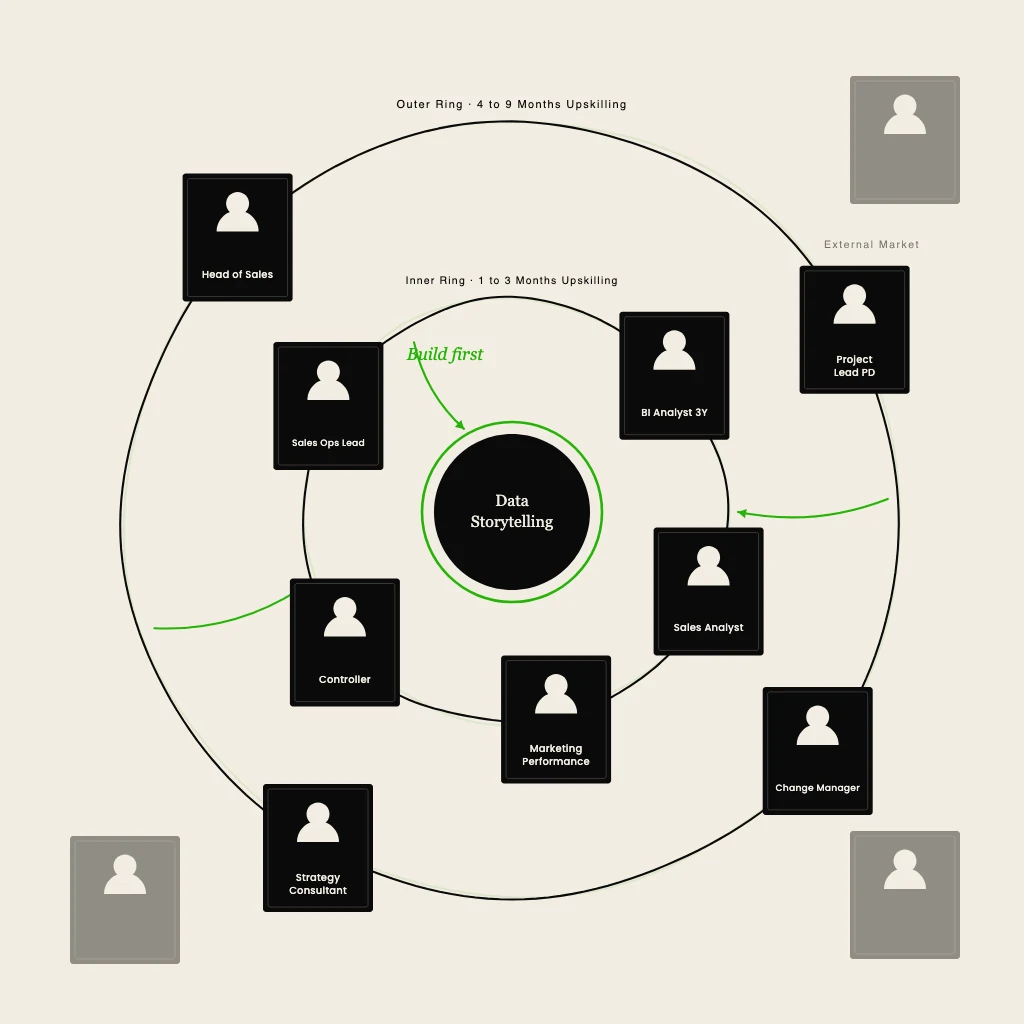
4HIHB Horizon - the neighborhood map in concrete terms
HIHB Horizon is the two-day strategy workshop in which the board, the CHRO and selected business-unit leaders extract the five to eight Critical-Few skills, anchor them behaviourally, and produce a neighborhood map for each individual skill. The output is a bound workshop book and a hand-drawn or digitally reproduced skill map per skill. Details on the workshop format can be found at hireworks.de/horizon.
The map has three zones.
Inner ring - one to three months of upskilling
The inner ring holds profiles whose current skill vector overlaps with the target skill at 60 to 80 percent. This is the zone of quick transitions: a three-month curriculum, a mentor match and an initial application project are enough to close the remaining skill difference. In the data storytelling example this typically means profiles from the business-intelligence team with three or more years of practice, sales analysts who run their own customer presentations, marketing performance leads, and controllers with experience presenting to the board. Four to five profiles, sometimes more.
Outer ring - four to nine months of upskilling
The outer ring holds profiles whose current skill vector overlaps with the target skill at 30 to 60 percent. Here a three-month curriculum is not enough. It needs accompanying coaching, a rotation into an adjacent team, and a sequenced project trial. In the data storytelling example these are often project leads from product development, change managers with presentation experience, consultants from the in-house strategy team, sometimes also sales colleagues without an analytics background but with strong narrative capability. Three to four profiles.
External market - beyond the internal range
Whoever does not sit in the first two rings falls out of the Build logic. This is not a negative judgement but a methodical finding. When the skill-vector overlap drops below 30 percent, the upskilling path is longer than the strategy horizons allow. Here you search externally, often through specialised executive search firms - and this is exactly where the link to our sister service corecruiting.com sits, which provides the co-recruiting mechanic for these cases.
The map is not generated by machine in the workshop. It is produced through moderation, in a choreographed sequence: skill definition with behavioural anchors, then a 100-percent allocation of the difference skills across three to five sub-skills, then the brainstorming of profiles - each workshop participant names three to five internal profiles that might sit in the rings. The profiles are anonymised (only function, business unit, depth of experience), not named. HIHB does not process personal data of employees.
The map is handed over to the client as a workshop output. The person matching - which named person fills which function-unit-experience profile - is done internally afterwards by HR leadership together with business-unit leaders in a half-day follow-up. HIHB provides the methodical map, the client does the matching. This separation is both privacy-aware and practical.
A note on the aesthetics of the map. We deliberately produce the map as a concentric-ring view, not a list. A list carries no proximity information. A map shows at a glance whether a skill has three profiles nearby or one, whether the profiles are thematically distributed or clump in a single business unit. This visual clumping is often the hidden signal: when all inner-ring profiles come from a single team, the Build wave is simultaneously a risk for that team. The map shows the trade-off, the list hides it.
A final observation from workshop practice. In two out of three mandates the adjacency map produces at least one surprise per Critical-Few skill - a profile no one had on the radar but which methodically belongs in the inner ring. These surprises are not anecdotes but the result of the mechanic. Because the workshop question forces business-unit leaders to look at the skill definition and not the personnel file, profiles come into view that the CV never made visible.
5Build, Buy, Hire - the decision framework
The adjacency map is not the end of a decision, it is the beginning. For each Critical-Few skill a Build/Buy/Hire decision waits at the end of the workshop, distributing the money of the next twelve to 24 months. The decision framework follows four questions.
Question 1: How many profiles sit in the inner ring?
If three or more profiles sit in the inner ring, Build is the most likely answer. Three months of upskilling per person, a mentor programme, an initial application - the budget size is typically 5,000 to 12,000 euros per person, depending on curriculum depth. Compared with an external senior hire (placement fee in the six-figure range plus a twelve-month poaching-risk premium), the Build variant is typically an order of magnitude cheaper on pure investment terms - and faster, because the external market for AI-adjacent skills today produces time-to-hire of six to nine months.
BCG made the point precisely in its 2025 reskilling study: companies can compare the cost of reskilling a person with the cost of letting someone go and filling the position externally - the calculation turns positive quickly, provided the programme has a certain scale.4 In the mid-market that scale is exactly what emerges from the inner-ring set: not a single curriculum for one person, but a mini-curriculum for three to five inner-ring profiles in parallel.
Question 2: How many profiles sit in the outer ring?
Outer-ring profiles are not the first Build step but the second. The methodical recommendation reads: inner ring first, because the lever is highest there. Outer ring second, when the inner ring does not fully cover the need. The outer ring is not a Buy argument but a second Build wave with a longer horizon.
Question 3: How time-critical is the skill?
If the skill is needed in the next twelve months at a single key position (for instance, to build a new business unit or to take over a critical board reporting line), Build alone is not enough. Here the Hire component joins: a senior position is filled externally, complemented by Build steps in the inner ring, so that after twelve to 18 months three to four internal profiles carry the skill in parallel. This hybrid logic is the methodically clean answer to the conflict between speed and depth.
Question 4: Where do you search externally?
The external market remains relevant for skills where no one internally sits in the first two rings. Here the adjacency map shows its second value: it says not only where Build is possible but also where Build would be pointless. When a Critical-Few skill produces neither inner-ring nor outer-ring profiles, that is a clear sourcing instruction: external, through specialised search partners, with deep benchmarking.
6What you save
The adjacency map produces value across four dimensions which should be named cleanly in the board discussion - without overstating with patents or quick-win promises.
First: cost difference Build versus Buy.
The direct cost calculation is the most obvious dimension. Senior hires for critical, AI-adjacent skills today sit in the six-figure fee range with external search, plus an additional poaching risk that is rarely calculated explicitly in most mandates. By comparison, inner-ring Build programmes are often an order of magnitude cheaper - especially when three or four profiles go through a curriculum in parallel. The map makes this comparison defensible at the board level for the first time. BCG documented exactly this point in its 2025 study: 40 percent of companies measure the effect of their reskilling initiatives, and the most effective incentive - the offer of a new role after programme completion - improves returns by a factor of 1.5 over programmes without that incentive.4
Second: time difference Build versus Hire.
Time-to-hire for senior profiles in AI-adjacent skill territory currently runs six to nine months, often longer. Time-to-build in the inner ring typically sits at three to six months - with the advantage that inner-ring profiles are productive from day one, while senior hires spend their first 90 days in onboarding. The map separates these timelines cleanly and answers the question "When is the role really filled?"
Third: cultural-fit difference.
Internal movers know the stakeholders, the codes and the unwritten rules. LinkedIn platform data shows that internally moving employees stay roughly 41 percent longer with the company than employees without internal mobility - we covered this in internal mobility as a recruiting strategy. In the adjacency context this means the internal move is not only cheaper on direct calculation but also on retention. A mis-hire in AI-adjacent skill territory quickly runs into the six figures in the mid-market - the full cost of a mis-hire covers onboarding investment, opportunity loss and successor recruiting. The internal Build variant reduces that risk structurally.
Fourth: strategic learning curve.
The underrated fourth dimension. When three internal profiles build a critical skill, the entire organisation learns how the skill works in practice within the company's own language, its own IT landscape and its own customer logic. An external senior hire brings knowledge from a different context and translates it step by step. An internal Build wave develops the skill directly in the native context. This learning curve pays back in the second and third iteration - the moment when the skill no longer affects a single function but is needed strategically across the organisation.
Gartner has stated the mechanism publicly: 58 percent of the workforce will need new skill sets to perform their tasks successfully in the coming years, and the number of skills per role grows by ten percent each year.3 Anyone who only buys the learning curve externally does not learn themselves - and falls behind on the next skill shift. Anyone who builds internally establishes a learning mechanic that can be repeated.
7Next step
The adjacency map solves a concrete problem: the supervisory board's question of whether you really had to start externally becomes answerable. The precondition is that the Critical-Few skills are cleanly defined and that the workshop mechanic actually surfaces the internal profiles in the first two rings. Both are part of HIHB Horizon.
If you owe a Build/Buy/Hire decision at the next board retreat, the first step is not the call to the headhunter. The first step is the question: "Who sits inside our company closer to the target skill than we think?" HIHB Horizon is the tool that answers this question in two days, methodically, with one map per Critical-Few skill and a decision basis that stands up in the supervisory board.
Internal mobility is the strategic lever the mid-market underrates most today. Whoever draws the adjacency map lifts that lever - before the external market decides for you.
Frequently asked questions
What is skill neighborhood?
Skill neighborhood (skill adjacency) describes which internal profiles can close in on a critical target skill, and with how much upskilling effort. Instead of just seeing a list of the Critical-Few skills, you answer for each skill: who in-house is close, who is reachable with effort, who sits outside the internal range?
Why do mid-market companies overlook skill neighborhood?
Three reasons: first, the HR-tech infrastructure is missing (no skills cloud, no talent marketplace). Second, the manual methodology that works without that platform is missing. Third, visibility is missing - CVs show titles and stations, not skill vectors.
What output does HIHB Horizon produce on skill neighborhood?
For each Critical-Few skill, HIHB Horizon delivers a neighborhood map with two rings. The inner ring (one to three months of upskilling) shows profiles with high skill overlap. The outer ring (four to nine months) shows profiles with medium overlap. Profiles outside both rings mark the point at which external search becomes necessary.
When does Build-before-Buy pay off in the mid-market?
Build pays off when three conditions coincide: the critical skill is methodically well-defined, at least three internal profiles sit in the first two rings, and the strategy horizon is twelve months or more. The external market remains relevant for skills where no one inside can close the gap within twelve months.
Sources
- ManpowerGroup, "Global Talent Shortage Reaches Turning Point as AI Skills Claim Top Spot", 2026 Global Talent Shortage Survey, 39,000 employers in 41 countries, fieldwork October 2025, published February 2026. Available at: manpowergroup.com. back
- Lightcast, Career Pathways API - Documentation. Skill-gap model across more than 32,000 individual skills, directed calculation between source and destination occupation, importance score per skill difference. Available at: docs.lightcast.dev/data-sets/career-pathways. back
- Gartner, "How Workforce Reskilling Meets Business Strategy" and Gartner HR Research, "58% of the Workforce Will Need New Skill Sets". Skills-adjacencies and skills-accelerators concept within the dynamic skills approach. Available at: gartner.com - Workforce Reskilling and gartner.com - 58% skill sets. back
- Boston Consulting Group, "Five Ways to Make the Most of Reskilling Investments", 2025. Reskilling cost versus external recruiting calculation, 40 percent measurement rate, ROLI effect through programme incentives. Available at: bcg.com/publications/2025. back

Leads the HIHB methodology at HireWorks. Has facilitated workshops since 2018 with management boards and hiring managers across DACH mid-market firms and large corporates.
A Critical-Few list on the table.
Two days to the adjacency map.
In the HIHB Horizon workshop we produce a neighborhood map for each Critical-Few skill, with an inner and outer ring. That turns Build-before-Buy into a concrete decision at the board level.
Discover HIHB Horizon