
Behavioural anchors instead of skill labels: how to genuinely spot future skills in the interview.
1The skill label in the interview
An HR director sits in the second interview for a critical hire. On the table lies a candidate's CV, in the skill profile sits one word: "Change Management". The candidate nods politely as the business-unit lead asks about it. She tells a story from a project three years ago, uses the word "transformative" and drops two tool names. The HR director writes "fits" next to the skill and knows, in the next second, that she has examined nothing.
This scene can be replayed indefinitely. With the label "strategic decision-making". With "data storytelling". With "AI collaboration". A skill name sits in the briefing, a story turns up in the interview, and at the end of the day an evaluation form carries a tick next to a line that nobody could explain in terms of what was actually being checked. Anyone honest in a one-to-one conversation will admit it. Most recruiting processes live with it because they lack the language to do it differently.
These assumptions are expensive. A critical hire in the mid-market costs, depending on the function and the salary band, between 80,000 and 250,000 euros from mandate to signed contract. Anyone who decides on the basis of a skill label that nobody has broken down into behaviour is wagering that investment on a semantic proximity between two words: the one in the briefing and the one in the CV. They often don't mean the same thing.
The solution is old and well documented. It is called behavioural anchors, in the technical literature Behaviorally Anchored Rating Scales, abbreviated BARS. It goes back to the industrial psychology of the 1960s and 1970s and has since been so widely established, in academic research and commercial assessment, that there is no serious debate left about whether the method works. The serious debate is why it still so rarely arrives in the mid-market interview - and how that changes.
2What behavioural anchors are, methodically
A behavioural anchor is the description of an observable behaviour in a concrete situation. Three ingredients make it: a situation, an action, an observable perception. Drop any one of the three and what remains is not an anchor but a judgement.
The method goes back to the early competency movement. In 1973, David McClelland argued in the American Psychologist that school grades and classical intelligence tests predict professional success less well than the observation of concrete behaviours at the workplace - a paper that shaped academic and industrial personnel diagnostics for decades and is referenced in the classics of subsequent years as the founding statement of the competency approach.1 In 1982, Richard Boyatzis published The Competent Manager on the basis of an investigation into roughly 2,000 managers across 41 different roles, presenting a competency model that methodologically underpins nearly every modern BARS application: 19 competencies in four clusters, each underlaid with concrete behavioural descriptions.2
What technically distinguishes BARS: instead of a scale such as "very good, good, satisfactory, poor", every level of a scale is anchored with a concretely observable behaviour. Instead of asking "How well can this person collaborate with AI?", you ask "Which of the four behaviours listed here do we observe in the conversation?". The question moves from judgement to observation. That is the small, hard shift on which the method hangs.
Forty years of psychometric research have demonstrated for BARS better inter-rater reliability, lower halo effect and lower leniency bias than for purely numerical scales. This holds not only in the academic literature but also in validation studies from academic medicine, teaching-effectiveness research and industrial personnel diagnostics.3 SHL too has systematically made the procedure available for recruiting in its Universal Competency Framework: per competency, SHL delivers "behavioural anchors", interview questions, assessment tasks and development pointers.4 DDI uses the same fundamental idea in its leadership-readiness assessment. Talent Q, Korn Ferry, Lominger - they all build evaluation architectures in which behavioural anchors form the load-bearing layer.
In the mid-market, the method still rarely arrives. The reason is not academic. The reason is effort. Formulating behavioural anchors costs time because, per skill, multiple stakeholders have to negotiate their observational expectations. Anyone who does not negotiate them ends up not with an anchor but with a statement of taste. Anyone who negotiates them ends up with the antidote to gut feeling.
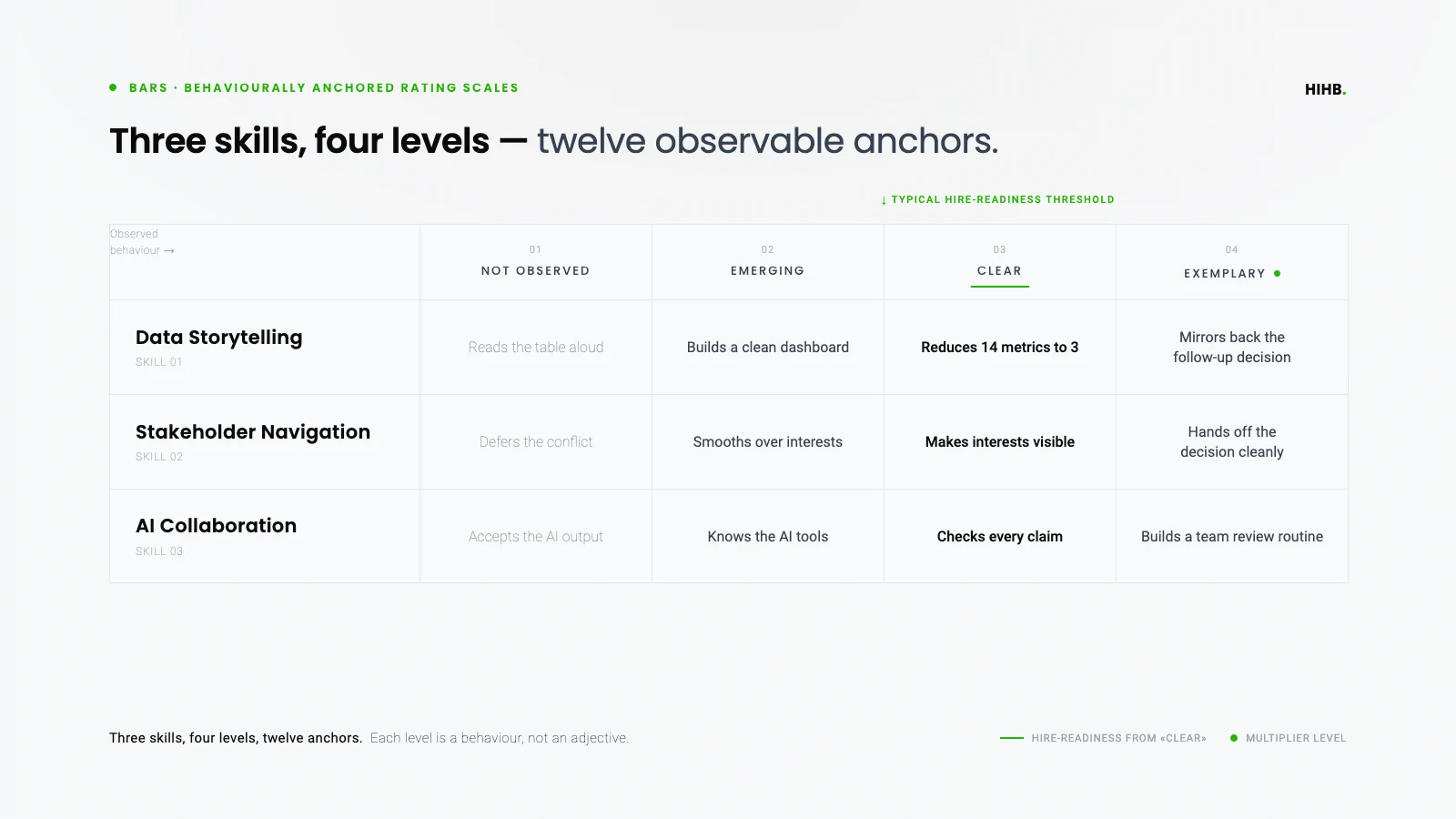
3Three skills, nine anchors
What does this look like in practice? Three example skills, three anchors each at the "clear" level. The skills are familiar as recurring Critical Few candidates from 200+ HIHB mandates. The anchors come from Horizon workshops with stakeholders in industry, tech and services.
3.1 Skill: Data storytelling
The expectation behind it: a person should prepare data so that the decision in the steering committee gets better. Not "knows the tools" but "turns numbers into a decision". Three anchors at the "clear" level:
- Situation: Q3 review in the steering committee. The person reduces an analysis with 14 KPIs down to three before presenting, because they identify the three as decision-bearing. Justifies the reduction in two sentences without devaluing the eleven left out.
- Situation: stakeholder question about the source of the data. The person openly names which of the numbers come from a hard source and which from estimation. Separates, in the same sentence, which statements they therefore advocate with which level of confidence.
- Situation: the recommendation slide. The person formulates the recommendation as a sentence with consequence and risk, not as a list of options. Thereby makes the steering committee's decision possible instead of deferring it.
The three anchors show what data storytelling is in the daily work: not dashboard building but enabling decisions. Anyone at the "clear" level does the above. Anyone at the "emerging" level can build dashboards but does not reduce and does not name data quality. Anyone at the "exemplary" level does the three anchors plus a fourth: pulls the consequence of the recommendation through the following months and reports back whether the steering committee's decision has held up.
3.2 Skill: Stakeholder navigation
The expectation behind it: a person should be able to build majorities in an organisation with competing interests, without binding themselves to a single side. A classic critical role in the mid-market with a family-led board, an advisory council and an operational management team. Three anchors at the "clear" level:
- Situation: conflict between sales and production over delivery priorities. Before the escalation meeting, the person seeks one-to-one conversations with both unit leads. Brings into the escalation meeting a preparatory outline that makes the interests of both visible, instead of smoothing them over.
- Situation: supervisory-board meeting with a critical question about strategy. The person answers the question without going around the responsible unit lead in the meeting. In the following sentence passes the detailed answer back to the unit lead and visibly hands over the floor.
- Situation: a politically dangerous decision between two board factions. The person does not defer the decision. Formulates the consequence of both options, names their own preference, leaves the decision to the body without further loops.
These three anchors separate the person who can navigate stakeholders from the person who placates stakeholders. In the interview the difference is hard to spot, because both types use the right vocabulary. Against the anchors the separation becomes visible.
3.3 Skill: AI collaboration
The expectation behind it: a person should use AI tools in a way that strengthens, not displaces, their own subject-matter expertise. Not "can operate ChatGPT" but "turns AI output into a professional basis for decisions". Three anchors at the "clear" level:
- Situation: an AI tool delivers a market analysis with three claims. The person checks each of the three claims against their own subject-matter knowledge. Keeps two, discards one with reasoning, documents the check in two sentences for traceability.
- Situation: a colleague suggests generating a customer letter entirely via AI. The person does not adopt the suggestion one-to-one but asks back which two passages in the letter need customer context that the model does not have. Edits those passages by hand.
- Situation: AI output hallucinates a statistic. The person spots the hallucination because they can cross-check the statistic. Flags the case in the team without dismissing AI in general, with a conclusion as to which kinds of tasks will be prompted differently in future.
The three anchors answer what AI collaboration is in the context of a critical role: a subject-matter expert who uses AI as a tool without surrendering their duty of verification. Anyone at the "clear" level does this. Anyone at the "emerging" level knows the tools but does not verify. Anyone at the "exemplary" level does the three anchors plus a fourth: builds structures in the team so that the verification of AI output becomes a shared routine, not an individual contribution.
4How HIHB Horizon produces anchors
Behavioural anchors do not fall from the sky and do not sit in a database. They emerge in a workshop in which the stakeholders of a critical hire agree on their observational expectations. HIHB Horizon is the method with which HireWorks moderates this workshop - built on the 5C logic that is anchored in the Pre-Recruiting method.

Per Critical Few skill, the Horizon workshop produces four to six behavioural anchors. The mechanics run in three steps. First: narrow the situation. The stakeholders describe two to three typical working situations in which the skill becomes visible. Without a situation, no anchor emerges - only a list of vocabulary. Second: formulate the behaviour. Per situation, a concretely observable sentence is written, with subject, action and observable perception. Third: anchor the scale. The four levels "not observed", "emerging", "clear", "exemplary" are played through until each level holds an anchor.
In the workshop, the hardest spot is not the formulation but the negotiation. Stakeholders often hold different observational expectations without knowing it. The HR director means by "stakeholder navigation" the calm moderation of conflicts. The business-unit lead means the rapid building of majorities. The supervisory board means that the position shows clarity in front of the body. The three expectations are not wrong, but they are three. The anchor forces a decision on which expectation will, in the end, be tested in the interview. That decision would never have become visible without the workshop.
Per critical hire, Horizon ultimately delivers an anchor set for five to eight Critical Few skills. The set is coded into the interview form, underlaid with the scale rating in the evaluation tool, and bridged into the 90-day plan. In this form, the method is a direct continuation of the persona definition from Edition II: persona describes who the person is, behavioural anchors describe what that person concretely does.
5How this works in the interview
In the interview, behavioural anchors take effect when the question stops asking about the skill label and starts asking about the situation. Three example questions from the Horizon interview set:
- Instead of "Do you have experience with data storytelling?" - the situation: "Tell me about the last quarterly review in which you presented a data analysis to a management team. How many KPIs were on the slide at the start, how many at the end? Who did the reduction, and on what argument?"
- Instead of "How is your stakeholder management?" - the situation: "Describe the last conflict between two business units in which you were involved. Whom did you speak to beforehand, and what did you bring into the escalation meeting?"
- Instead of "How do you use AI?" - the situation: "Give me the last task in which you used an AI tool. What did it deliver, what did you change, why? Where did you check it against your own subject-matter knowledge?"
The candidates' answers are mirrored against the anchors. An example: in response to the second question, a candidate replies that he "brought both sides together" and "found the win-win solution". That fits none of the three anchors at the "clear" level - the anchors speak of one-to-one conversations, of preparatory outlines, of making interests visible instead of smoothing them. The candidate therefore sits at the "emerging" level. That is not a devaluation but a clarification. Anyone at the "emerging" level who lands in a role that requires "clear" gets, in the 90-day plan, a concrete development objective instead of a vague expectation.
What should not be evaluated in the interview: the rhetorical quality of the answer. A candidate who tells a beautiful story is not automatically better. The anchors ask about actions, not narratives. A very brief, prosaically clumsy answer that hits exactly the three anchors is, in the outcome, better than an eloquently sprawling one that hits none of them. This separation matters in the mid-market because the interview culturally favours the storyteller - and the storyteller is not always the doer. This point connects directly with the cultural-fit distortions we have discussed elsewhere at greater length.
Equally important: anchors are not read aloud in the interview. The evaluators know them, the candidates do not. Anyone who discloses the anchors gets answers that serve the anchors without the behavioural reality behind them. The method assumes that the evaluators are trained - that is the second precondition next to the formulation of the anchors themselves.
6Anti-patterns: how NOT to formulate anchors
Four recurring mistakes appear in workshops where stakeholders work with behavioural anchors for the first time. They are all well intentioned and they all destroy the method.
Mistake 1: trait attribution instead of behaviour. A typical first attempt reads "Is proactive". That is not an anchor. It is a trait attribution that leaves every candidate observer free to decide whether "proactive" was just on display or not. The corrected anchor reads something like: "Speaks up in the weekly team sync with their own suggestions before the moderator explicitly asks. Has prepared the suggestion in writing."
Mistake 2: repeating the skill label inside the anchor. Anyone who writes "Demonstrates clear data-storytelling capability" has not formulated an anchor; they have put an adjective in front of the label. The anchor does not need to contain the vocabulary of the skill. If the behaviour is concrete enough, every reader knows which skill is meant.
Mistake 3: dropping the observable perception. An anchor such as "Understands customer needs" hangs in the air, because nobody can observe "understanding". The corrected anchor makes the understanding visible: "Repeats the customer need in the following sentence in their own words. In doing so, corrects an assumption of their own if it does not match what the customer said."
Mistake 4: levels that don't discriminate. Anyone who, across the scale "not observed", "emerging", "clear", "exemplary", changes only gradient adverbs between anchor sentences ("Does it partially", "Does it", "Does it very well") has built not anchors but a numerical scale in disguise. Discriminating levels need different behavioural descriptions - not the same sentence at a different intensity.
When these four mistakes surface in the workshop, that is a good sign: the stakeholders are learning the method. The correction takes between two and five minutes per anchor. It is the actual work output of the workshop. The anchors that end up on the wall are no longer negotiable - they are the shared observational language against which the interview, the 90-day plan and the later performance conversation will all test the same behaviour.
7Conclusion: from label to test
Anyone who looks into a candidate's CV and reads "Change Management" has no information. They have a promise. Without behavioural anchors it stays a promise that is confirmed or denied in the interview, depending on who nods how politely. With behavioural anchors it becomes a test: against concrete behaviour, in a concrete situation, against a shared expectation. The methodological weight of the skill question does not sit in the skill label but in the formulation of the anchor. Anyone who has the anchors has the test. Anyone who doesn't has the gut feeling.
The method is not an HIHB invention. It is a 50-year tradition from industrial psychology, from McClelland's 1973 paper, from Boyatzis's 1982 study, from SHL's Universal Competency Framework and from the psychometric validation literature. HIHB Horizon transfers it to critical hires in the mid-market and integrates it into the Pre-Recruiting workshop, in which Critical Few skills are determined and translated into observable behaviour. That is the jump that takes "Skills of the Future" from buzzword to practice: not in the catalogue but in the anchor.
Frequently asked questions
What is a behavioural anchor in a recruiting context?
A behavioural anchor is the description of an observable behaviour in a concrete situation that makes an abstract skill measurable. Instead of naming "Change Management" as a skill label, the behavioural anchor describes what a person concretely says or does in a conflict between two business units. The method originates from Behaviorally Anchored Rating Scales (BARS) and is an established technique for the interview, performance review and curriculum design.
What is the BARS method?
BARS stands for Behaviorally Anchored Rating Scales and is an evaluation procedure that anchors a scale with concrete behavioural examples. Rather than asking "very good to poor", each level describes a concrete behaviour in a typical working situation. The method was developed in the 1960s and 1970s in industrial psychology and is considered in the research literature more reliable than purely numerical scales. SHL has systematically made it available for recruiting in the Universal Competency Framework.
How many behavioural anchors does a future skill need?
HIHB Horizon produces four to six behavioural anchors per Critical Few skill. Four is the floor because the scale must at minimum cover "not observed", "emerging", "clear" and "exemplary". Six is the ceiling because more anchors overload the interview and evaluators lose the overview. The anchors are formulated with stakeholders in the workshop, not pulled from a database.
What is the difference between a skill label and a behavioural anchor?
A skill label is an abstract word such as "AI collaboration" or "stakeholder navigation". It names a capability but does not describe it. A behavioural anchor is the concrete, observable manifestation in a situation: "Confronts an AI output against their own subject-matter knowledge and names the conflict openly." Skill labels cannot be examined in the interview. Behavioural anchors can.
Sources
- McClelland, David C., "Testing for Competence Rather Than for 'Intelligence'", American Psychologist, Vol. 28(1), 1973, pp. 1-14. Foundational paper of the competency movement; argument that observed behaviour is a better predictor of professional success than intelligence tests. Available in the APA PsycNet database: psycnet.apa.org/record/1973-22126-001. ↩
- Boyatzis, Richard E., The Competent Manager: A Model for Effective Performance, John Wiley & Sons, New York, 1982. Investigation of approximately 2,000 managers in 41 different roles across 12 organisations; identifies 19 competencies in four clusters with observable behavioural descriptions. Available in the Internet Archive: archive.org/details/competentmanager0000boya. ↩
- On the psychometric validity of BARS see, representatively: Lopez Garcia et al., "Assessing Teaching Effectiveness in Blended Learning Methodologies: Validity and Reliability of an Instrument with Behavioral Anchored Rating Scales", Frontiers in Psychology, 2022 (Cronbach's alpha 0.956, RMSEA 0.042, variance explained 77.6%): ncbi.nlm.nih.gov/pmc/articles/PMC9598132. And the early reliability study by Stoskopf et al., "The Reliability and Construct Validity of a Behaviorally Anchored Rating Scale Used To Measure Nursing Assistant Performance", Evaluation Review 16(3), 1992. ↩
- Bartram, Dave, "The SHL Universal Competency Framework", SHL White Paper, 2012. Describes the "Great 8" competency factors with 20 dimensions and the associated behavioural anchors, interview questions and assessment tasks. Available as a PDF: shl.com/assets/campaigns/global/competency-fit/universal-competency-framework-whitepaper-en.pdf. ↩

Leads the HIHB methodology at HireWorks. Has moderated workshops since 2018 with management boards and hiring managers across DACH mid-market firms and large corporates. HIHB Horizon is the method for the strategic skill architecture in the Pre-Recruiting phase.
A critical hire with future skills:
get to know the Horizon workshop.
In the Horizon workshop we determine your five to eight Critical Few skills and formulate four to six behavioural anchors per skill. In a 30-minute scoping conversation we clarify whether the method fits your critical hire.
Discover the Horizon workshopContinue to the related methodology: Hire the person, not the checklist describes how a skill profile becomes a concrete person - the methodological sister of behavioural anchors.