
Vibe hiring: why "cultural fit" becomes a diversity killer in 2026.
1The diagnosis: "fits with us" as code
"Cultural fit" has been one of the most-cited recruiting criteria for years. A person with a high cultural-fit score is treated as more valuable than an equally qualified one with a lower score. That sounds reasonable: culture matters, conflicts are expensive.
In practice, "cultural fit" is often code for something else. "Fits with us" frequently means: "looks like us, comes from a similar background, has a similar biography, communicates the way we communicate." It is not intentionally discriminatory; it is the unconscious effect of a vague criterion.
2The data: 36 percent performance lead for diverse top-quartile firms
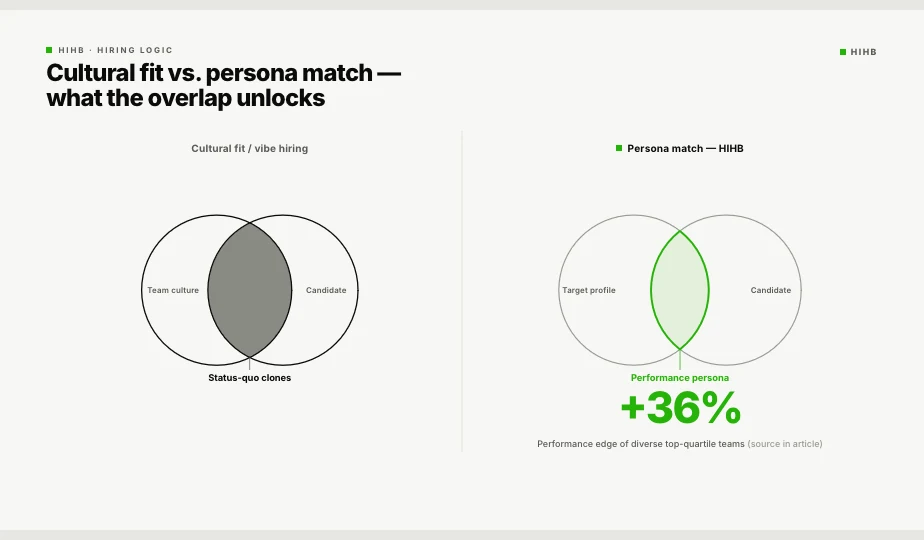
McKinsey's study "Diversity Wins: How Inclusion Matters" (2020) examined the link between leadership diversity and profitability across more than 1,000 companies in 15 countries in a longitudinal analysis. The finding: companies in the top quartile for ethnic and cultural diversity in their executive teams outperformed those in the bottom quartile by 36 percent. For gender diversity, the lead was 25 percent.1 The 2023 update "Diversity Matters Even More" confirmed and broadened the correlation.2
… for companies in the top quartile for ethnic and cultural diversity versus the bottom quartile. Cultural-fit rhetoric works structurally as a diversity filter and systematically blocks the variety that demonstrably correlates with better performance.
The implication is not to abandon culture as a criterion. It is to replace the vague concept "cultural fit" with something more precise: a persona definition independent of demography and biography.
3Persona as objective alternative
An HIHB persona definition rests on seven dimensions, all of them independent of demography:
- Functional depth: Is the functional background there, and to what degree?
- Learning agility: How is learning anchored? What did the person learn from mistakes, and when did they not?
- Communication: How do they communicate praise, criticism, mistakes (others' and their own), new insights, and a why?
- Way of working: How do they handle ad-hoc requests? How do they sequence tasks and goals by order and priority? Which formats do they use for productive collaboration?
- Drive and values: What moves this person for the long run, which values will they not give up, and what does success mean to them?
- Environment fit: Which culture, leadership and team constellation does the person need to be effective?
- Life and career stage with risk appetite: Where is the person biographically, and how much security or risk are they looking for right now?
These seven dimensions are objectively verifiable: through interview questions, through reference checks, through observation in the recruiting process. They are independent of whether the person looks like the existing team, attended a similar university, or has similar hobbies.
Result: whoever uses persona instead of cultural fit as the criterion opens the candidate pool to people the cultural-fit filter would have screened out, and at the same time excludes people who "seem to fit" but will not succeed in the role by persona match.
4What changes in the HIHB Workshop
In the HIHB Workshop, the cultural-fit question is deliberately not asked. Instead, in step C-4 (Coordination) of the 5C Method the persona definition is walked through against the seven dimensions above. When stakeholders raise "cultural fit" as a criterion, the question follows: "What exactly do you mean? Which of the persona dimensions would concretely be affected?" That translation often makes clear that "cultural fit" was either one of the persona dimensions (then name it cleanly) or a demographic code (then deliberately leave it out).
The result: diversity is no longer a special initiative but a side effect of disciplined persona definition. In 2026, that is one of the most effective forms of diverse hiring: not through quotas but through cleaner selection criteria - and it pairs naturally with an internal mobility programme that keeps the talent pool broad in the first place.
Frequently asked questions
What is the difference between cultural fit and persona in recruiting?
Cultural fit asks: does this person fit with us? Persona asks structurally across seven dimensions, from functional depth through working style to environment fit and life stage. Cultural fit is intuitive and subjective; persona is methodical and verifiable.
Why does cultural fit kill diversity?
Because cultural fit often rests, unconsciously, on demographic and biographical similarity to the existing workforce. "Fits with us" frequently means "looks like us". Diverse candidates are systematically rejected as "not quite fitting".
How do you replace cultural fit with persona in the briefing?
By defining the seven persona dimensions clearly: functional depth, learning agility, communication, working style, drive and values, environment fit, and life and career stage with risk appetite. These dimensions are independent of demography and biography.
Sources
- Sundiatu Dixon-Fyle, Kevin Dolan, Vivian Hunt, Sara Prince, "Diversity wins: How inclusion matters", McKinsey & Company, May 2020. Available at: mckinsey.com/featured-insights/diversity-and-inclusion/diversity-wins-how-inclusion-matters. ↩
- Dame Vivian Hunt, Sundiatu Dixon-Fyle et al., "Diversity matters even more: The case for holistic impact", McKinsey & Company, December 2023. Available at: mckinsey.com/featured-insights/diversity-and-inclusion/diversity-matters-even-more-the-case-for-holistic-impact. ↩

Leads the HIHB methodology at HireWorks. Has facilitated workshops since 2018 with founders, management boards, recruiting teams, and hiring managers across DACH mid-market firms, large corporates, and start-ups.
"Cultural fit" as a criterion: how do you actually mean that?
Fifteen minutes to sharpen the persona.
In 15 minutes we test how you can replace the cultural-fit criterion with an objective persona definition, without losing diversity.
Book a 15-min fit call