
A job ad contains only 10% of the information - what recruiters really need.
1The 10% thesis
In a typical critical hire, recruiting begins with a job ad as the main information source. What does it contain? A task description, a requirements list, standard boilerplate about company culture, optionally a salary range. What does it not contain? Stakeholder expectations, breakpoints, persona definition, 90-day plan, political context.
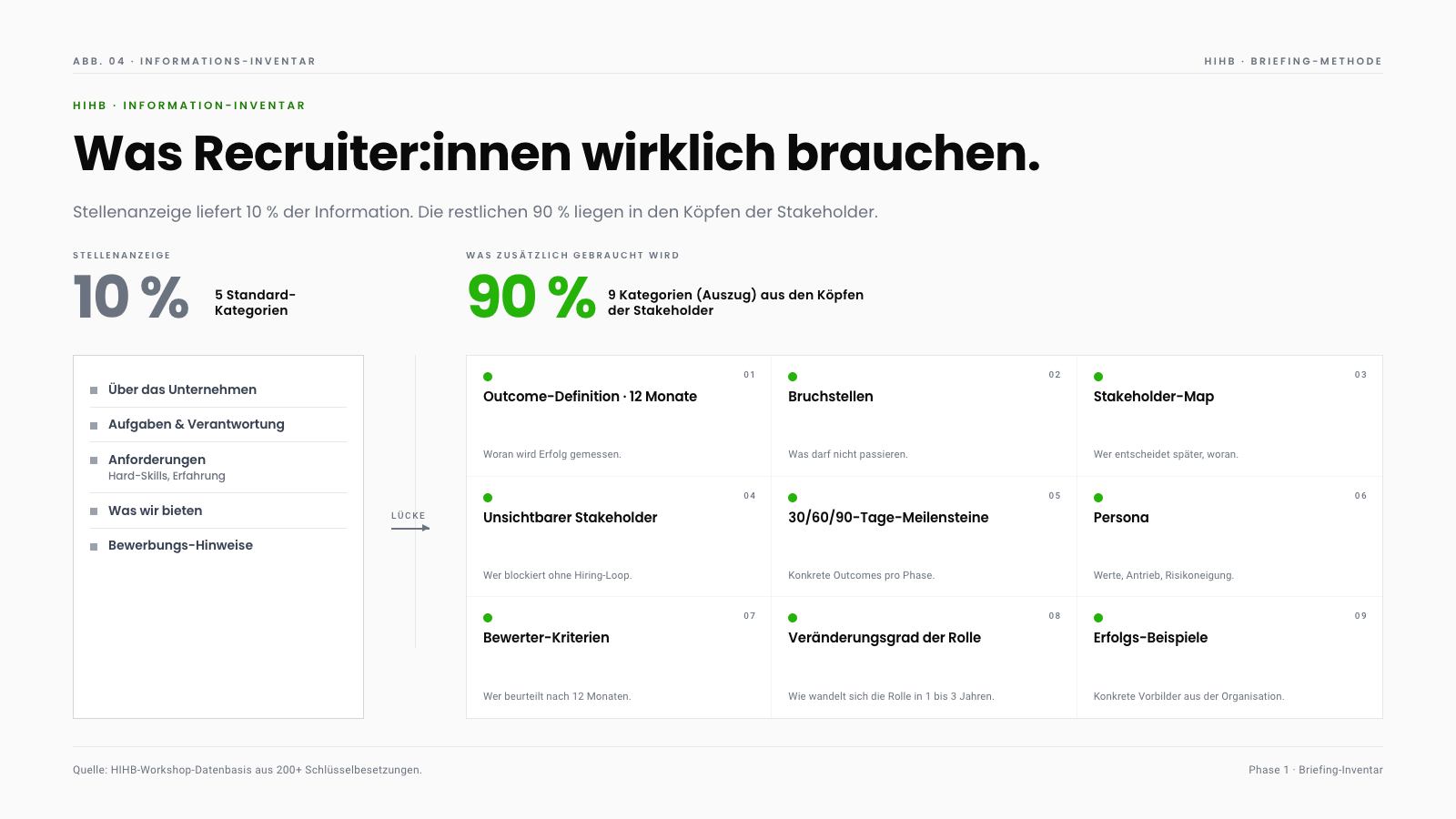
Across 200+ HIHB workshops with management boards and hiring managers, we have documented the comparison systematically: a job ad contains, on average, 10% of the information actually relevant to a successful critical hire. The missing 90% is what separates a 60% 12-month retention rate from a 95% one.
External data points support the diagnosis: McKinsey observes that in many organisations, 20 to 30% of critical roles are not filled with the best-fitting person.1 Korn Ferry reports that skill-focused organisations are 57% more likely to anticipate and respond to change.2 SHRM puts the cost of a bad hire at six to nine months' salary to replace.3 All three findings share one root cause: the briefing information before recruiting starts.
… of the information relevant to a critical hire is typically contained in the job ad. The other 90% sits in the heads of stakeholders and is rarely surfaced systematically in the briefing process.
2What typically appears in job ads
An average critical-role job ad in the DACH mid-market contains the following elements, in this order:
- About the company: 2 to 3 sentences, often generic ("We are a growth-oriented company…")
- Tasks and responsibility: 5 to 8 bullet points ("You are responsible for / steer / lead…")
- Requirements: 5 to 8 bullet points on hard skills, experience, qualifications
- What we offer: standard list (flexible hours, training, etc.)
- Application notes: contact, application channel, optionally salary range
That is the 10% information. It is not wrong, it is just incomplete. It is enough to attract standard applicants. It is not enough to find the right person for the specific role in the specific organisation.
3The missing 90%
Of course, that 90% is not entirely new information. The point is to make the knowledge already held by hiring managers and recruiters visible through structured questions, a visual method, and context - and to draw new insight from it. The advantage of having that information on one surface is enormous, and the conclusions the facilitator draws out are part of the value. Equally important, if not more so, are the participants' own insights. When tasks and goals are weighted and placed in relation to each other, there is no right or wrong: there is the clarity to see where roles build in friction from the start. That friction costs performance.
The following table shows, illustratively and in excerpt, which information is relevant to a successful critical hire and whether it typically appears in the job ad.
| Information | In the job ad | Actually required |
|---|---|---|
| Tasks & responsibility | ✓ | ✓ |
| Hard-skill requirements | ✓ | ✓ |
| Standard soft skills | ✓ | partly |
| Outcome definition (12 months) | ✗ | ✓ Required |
| Breakpoints: what must not happen | ✗ | ✓ Required |
| Stakeholder map (who decides later?) | ✗ | ✓ Required |
| Political context (invisible stakeholder) | ✗ | ✓ Required |
| 30/60/90-day milestones | ✗ | ✓ Required |
| Persona (values, life phase, drive, risk appetite) | ✗ | ✓ Required |
| Evaluator criteria (who judges at 12 months?) | ✗ | ✓ Required |
| Degree of role change over 1–3 years | ✗ | ✓ Important |
| Concrete success examples from the company | ✗ | ✓ Important |
The majority of the information that decides critical-hire success does not appear in job ads. It sits in the heads of stakeholders: with the hiring manager, the management board, the HR lead, the direct line manager, the invisible stakeholder.
4Why job ads cannot deliver this
There are three structural reasons:
Reason 1: format constraint
Job ads are public. Breakpoints ("What must not happen?") and political context ("Who can block success?") are not suitable for public communication. Even if hiring managers had this information, they could not publish it in the ad.
Reason 2: implicit-knowledge bias
Hiring managers are so deep in their role that they take context information for granted and therefore do not make it explicit. The recruiter who walks out of a 60-minute briefing knows the obvious points. What they do not know: what the hiring manager assumes goes without saying.
Reason 3: stakeholder-disagreement avoidance
When three stakeholders hold different expectations of the role, the briefing conversation often does not address that openly - out of courtesy, politics, or time pressure. The job ad then becomes the "lowest common denominator" of those three expectations. That reduction is exactly where the decisive 90% gets lost.
5How recruiters surface the missing 90%
The most effective method: a structured pre-recruiting workshop with all key stakeholders in one room. The recruiter's task (or that of an external facilitator) is to address the five systematic failure modes of briefing gaps.
- The evaluator question: Who decides in 12 months that the role is "filled correctly"? Against which criteria?
- The breakpoint question: What must absolutely not happen in this role?
- The stakeholder question: Who can block success without sitting in the hiring loop?
- The 90-day question: Which three milestones in the first 90 days?
- The persona question: What persona sits behind the requirements list?
Once those five questions are answered before recruiting starts, the briefing is no longer 10% information, but 80 to 90%. The job ad remains the "lowest common denominator" for public communication. The recruiter-internal briefing document carries the rest.
That internal briefing document, not the public job ad, becomes the real source of a successful hire.
Frequently asked questions
What percentage of the information relevant to a critical hire does a job ad contain?
On average, about 10%. Job ads typically contain task descriptions, hard-skill requirements, and standard boilerplate. The information that actually decides success (breakpoints, stakeholder map, political context, 90-day plan, persona) is for structural reasons not publicly communicable and sits in the heads of the stakeholders.
Why isn't a good job ad enough for a successful critical hire?
Three structural reasons: first, critical information (breakpoints, political context) is not publicly publishable. Second, hiring managers often take context for granted and do not make it explicit. Third, the job ad becomes the "lowest common denominator" of multiple stakeholder expectations, smoothing away the decisive information.
How can a recruiter pull the missing 90% of information out of the stakeholders?
The most effective path is a structured pre-recruiting workshop with all key stakeholders in one room, facilitated under an explicit method (for example, the HIHB Workshop with the 5C Method). The presence of all parties plus a methodical question sequence makes the typically implicit information explicit.
Sources
- McKinsey, "McKinsey research indicates that 20 to 30% of key roles are not filled by the most suitable people". Cited in: SHRM, "Recruitment Is Broken. Automation and Algorithms Can't Fix It". Available at: shrm.org/.../recruitment-is-broken. ↩
- Korn Ferry, "2024 Talent Acquisition Trends Report". Key finding: skill-focused organisations are 57% more likely to anticipate and respond to change. Available at: kornferry.com/about-us/press/korn-ferry-unveils-2024-talent-acquisition-trend-predictions. ↩
- SHRM, "Employers will need to spend the equivalent of six to nine months of an employee's salary in order to find and train their replacement". Published 2024. ↩

Leads the HIHB methodology at HireWorks. Has facilitated workshops since 2018 with founders, management boards, recruiting teams, and hiring managers across DACH mid-market firms, large corporates, and start-ups.
Have a concrete critical role on your desk?
Fifteen minutes is enough for a first read.
We talk for 15 minutes - honest, no pitch. You leave knowing whether an HIHB Workshop pays off for you.
Book a 15-min fit call